
Technical translation is essential today, both in the industrial and scientific fields. Globalization has made it a necessity to provide all kinds of documentation in various languages to adhere to local and international guidelines.
Technical translation is a key tool for any international company that wants to provide their employees and customers with information in their mother tongue.
But technical translation can also be a very challenging endeavour.
It deals with technical materials, such as documents, protocols, manuals, etc., and is characterized by the use of technical and scientific terminology.
This, in turn, implies that a technical translator needs special expertise.
In addition, when translated into other languages, technical content requires utmost precision.
What’s more, a thorough comprehension of even the most subtle nuances of technical language is crucial for maintaining high-quality output.
In the following blog, we are going to discuss in more detail the scope, challenges, and best practices of technical translation, so keep reading!
ARE YOU LOOKING FOR EXPERT TECHNICAL TRANSLATIONS?
Our team of expert professionals will help you seamlessly translate your technical content into 70+ languages with the highest quality and accuracy.
What is technical translation? What does it include?
The scope of technical translation is rather broad and includes a wide range of technical documents and materials. Any text that contains specialized, complex terminology is considered technical.
Due to its particular style and language, technical translation requires specialized knowledge of the subject matter.
Moreover, technical translation extends to different media, such as video and audio materials, diagrams, charts, blueprints, technical and CAD (computer-aided design) drawings, etc.
In some cases, businesses may choose to pay for a PowerPoint presentation through a trusted service to ensure technical accuracy and consistent terminology across multilingual materials.
In terms of domains that technical translation covers, it’s a long list. Some of the main areas include information technology, science, engineering, medicine, etc.
Also read: Scientific Translation: 4 Major Reasons To Translate Your Research
What are the types of documents and content in technical translation?
In technical translation, there are dozens of different types of documents and content. Here are the main categories:
- User, Maintenance, or Instruction Manuals
- Patents
- Technical reports
- Engineering documents
- Product specifications
- Software documentation
- Scientific research papers
- User Guides
- Operational and employee handbooks
- eLearning Courses and Training
In some industries, providing technical information in various languages is mandatory, which makes technical translation a necessity. Here are some examples:
- Atomic companies
- Pharmaceutical companies
- Tech-savvy companies
- Government organizations
- Manufacturing firms
- Agricultural plants
- Chemical plants
- Engineering fields
- Automotive companies
- Heavy Equipment Manufacturers
At present, technical translation is among the professional translation services with the highest demands.
Also read: Pharmaceutical Translation: Importance, Challenges & Best Practices
Challenges in technical translation
As already mentioned, technical translation is a complex task. And as you might expect, there are quite a few stumbling blocks along the way.
However, being aware of them is the first step to overcoming them.

Also read: ICF Translation: Importance, Requirements & Best Practices
Complex terminology
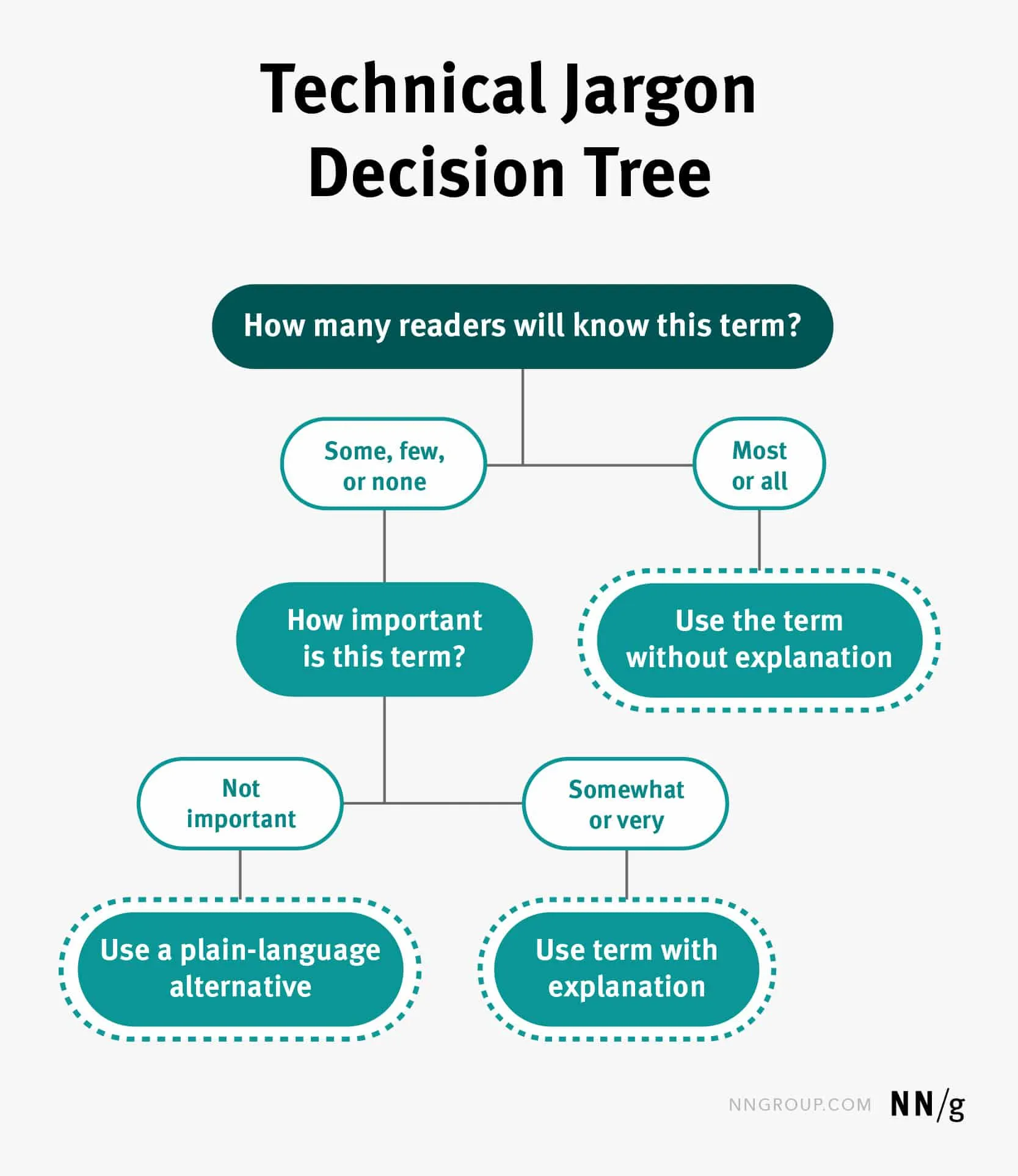
Technical terminology is among the biggest challenges in technical translation. There are various terms, and some of them might look very similar, but they might still denote completely different concepts.
Thus, a good command of the target and source languages is not enough. A good technical translator should be well-acquainted with the technical terminology of the domain they work in. Otherwise, ambiguities or even errors might occur in the final translation.
To assist translators when working with complex technical terminology, there are a few translation tools. We will discuss them in more detail in the following sections.
Accuracy in conveying technical concepts
Accuracy and precision are a must in technical translation. However, sometimes translating technical concepts can be quite difficult.
Finding the right equivalent in the target language can be impossible simply because it does not exist.
In such cases, it might seem out of the question to achieve accuracy.
Well-trained professional translators, however, have a few tricks up their sleeves in such situations.
They might include a detailed explanation of the concept, and create a completely new word to denote the concept. A third option is transliteration – the process of transferring a word from the alphabet of one language to another.
Also read: EU Machinery Directive 2006/42/EC: Translation Requirements
Cultural & linguistic nuances
There is a common misconception that technical language and technical texts have a simple structure, and thus, the process of translation is straightforward.
Such claims completely overlook the fact that in every language, there are certain cultural and linguistic nuances that, when disregarded in the translation process, might lead to confusion and misunderstandings.
Technical translators are trained to discern such nuances in meaning. What’s more, they know the right techniques to transfer them into the target text so that no details get lost.
Large volume
Technical texts can be quite voluminous. Technical guides, protocols, patents, etc. should describe in detail every aspect of the subject they are created for.
As you can imagine, including detailed descriptions and explanations can quickly lead to documents, containing tens or even hundreds of pages.
This, in turn, can result in longer delivery times. However, translation technology has something to offer in this regard. Keep reading to find out more.
Also read: Top Translation Companies in the UK & How To Choose The Right One
Consistency
Maintaining consistency in long, detailed technical texts is a real challenge.
Every technical translation project begins with a discussion of the terminology, style, tone, etc. that the client would like to see in the final translation. Effective goal setting at the outset can significantly streamline the entire process.
During the translation process itself, it is among the translator’s duties to look out for inconsistencies in the terminology as well as to maintain the same style and tone.
GET YOUR TECHNICAL DOCUMENTS TRANSLATED BY PROFESSIONALS
Our team of expert professionals will help you seamlessly translate your technical content into 70+ languages with the highest quality and accuracy.
Best practices in technical translation
If you want to achieve the best result possible, you have to keep in mind a few best practices in technical translation.
These will help you achieve your goals quickly and efficiently.
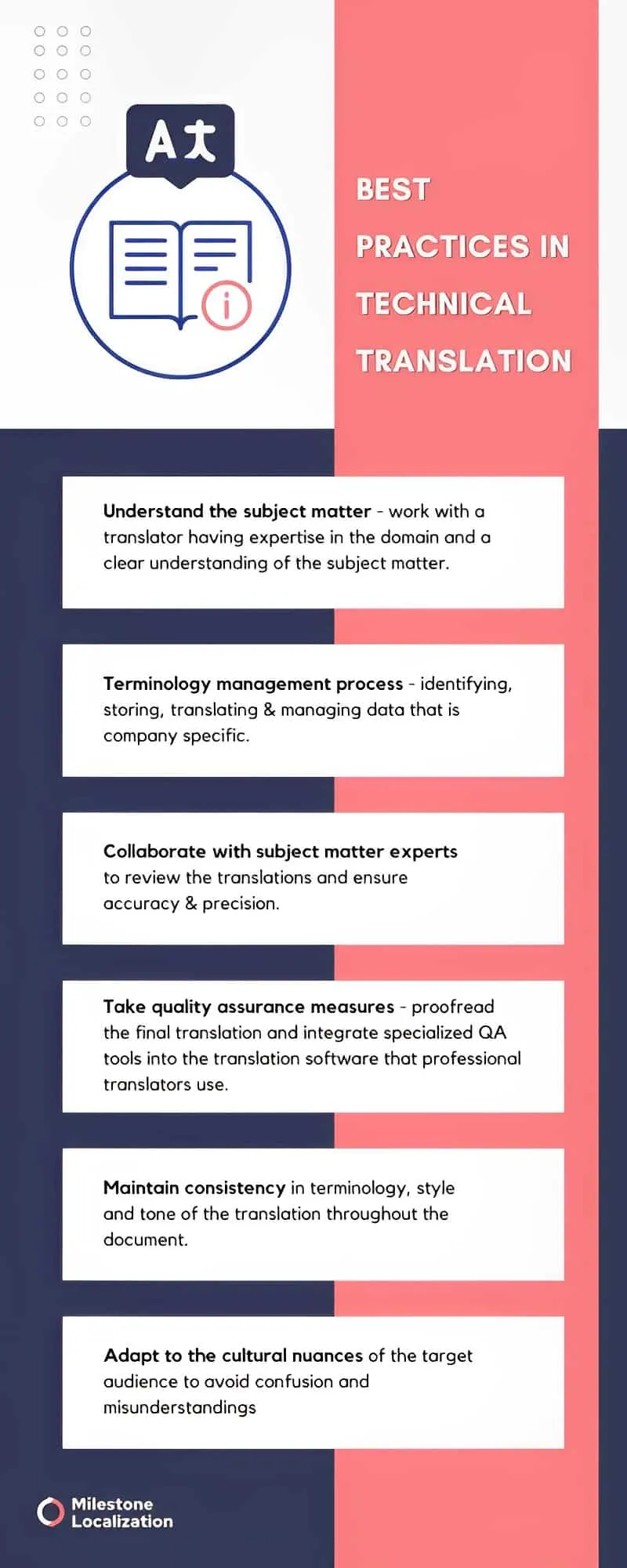
Understand the subject matter
To ensure a high-quality final translation, a technical translator is required to be a subject matter expert.
In other words, a well-trained translator is well-acquainted with the technical jargon in all working languages.
What’s more, good technical translators are also trained in the right techniques for researching unfamiliar terminology. They have the resources to look for the information they need quickly and efficiently.
Also read: Best Practices for Building a Multilingual Website
Terminology management process
Terminology management is the process of identifying, storing, translating, and managing terminology that is product or company-specific.
Simply put, terminology management is the process of building databases or glossaries with lists of terms and their preferred translations.
The contents of the lists are determined by the client and discussed with the language service provider.
While the lists usually contain terms and their equivalents in the target languages, termbases are often composed of essential explanations, notes, definitions, examples, images, graphs, etc.
Collaborate with subject matter experts
To ensure accuracy and precision, subject matter experts actively participate in the translation process.
While they might not be language experts, they can evaluate translations concerning comprehensiveness and accuracy of terminology.
Collaborating with subject matter experts is among the best ways to ensure high-quality end translations.
Quality assurance measures
Quality assurance handles the very last step of the translation process, and, as its name suggests, it aims to ensure the high quality of the final translation.
Different specialized QA tools can be integrated into the translation software that professional translators use. These tools check for terminology consistency as well as any other mistakes that might occur.
Another QA measure is proofreading the final translation. This step is usually performed by a translator who is unfamiliar with the translation project at hand. They read through the final translation and evaluate it.

Maintain consistency
We have already touched upon terminology management tools, which are incredibly helpful in achieving and maintaining terminology consistency.
However, maintaining terminology consistency is not the only aspect that the translator should keep an eye out for.
Each text has a particular style and tone, which are determined by the type of text and the target audience.
In this regard, translators need to make sure that they maintain the same style and tone across the whole translation.
Adapt to cultural differences
Besides languages, professional translators are familiar with the cultural norms, beliefs, and customs of the target locale the translation project is aimed at.
In this way, they can adapt the translation project to the cultural peculiarities of the target audience to avoid confusion and misunderstandings.
What’s more, by considering the cultural system of the target audience, the translator can create a translation that deeply resonates with their values and beliefs.
Tools and Technologies for technical translation
To achieve a more efficient translation process and reduce costs, professional translators utilize various translation tools and technologies.
Here are some of the most popular (and effective) choices in translation software and tools:
CAT tool (Computer Assisted Translation tool)
CAT tools are translation software that automates and thus speeds up the translation process.
While CAT tools do not replace the human translator, they allow for a much more efficient workflow.
Most CAT tools have integrated terminology databases, translation memory, and language search engines that aid human translators in their work.

What’s more, this type of software automates some tedious tasks, such as extracting text from PDF files or keeping the same format as the source text.
As a result, translators can solely focus on what they do best – translate.
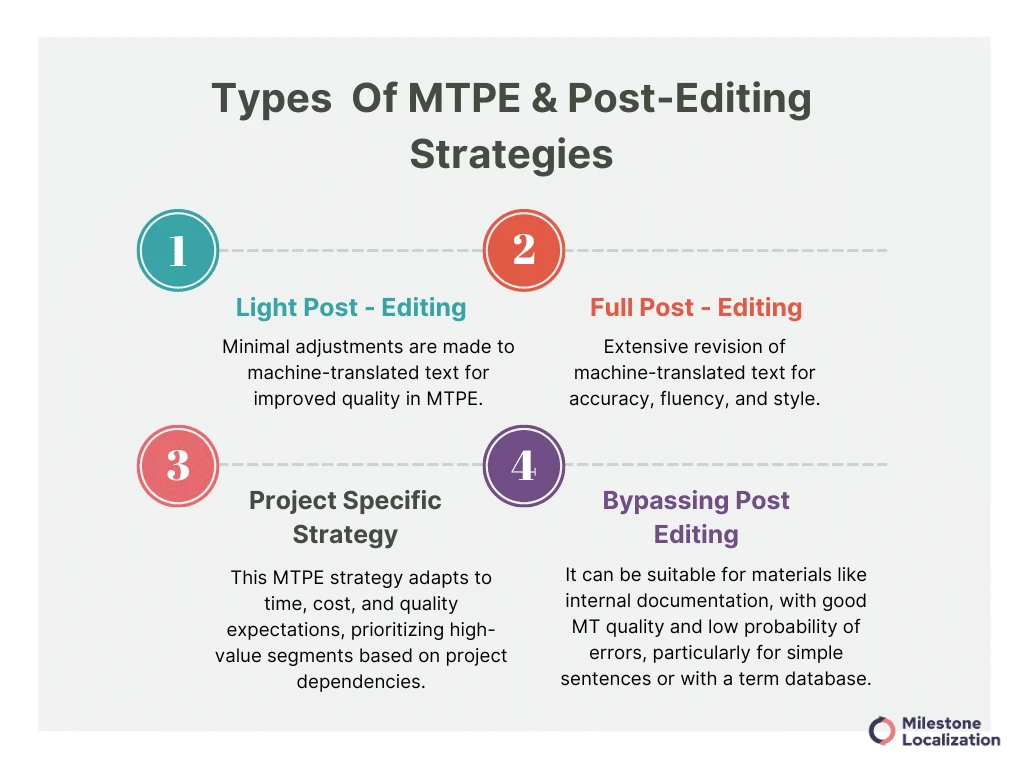
MTPE (Machine Translation Post-Editing)
MTPE is currently among the most frequently used translation techniques, and many believe that it’s the best one out there.
MTPE is a symbiosis between a human translator and a machine translation engine. This technique combines the best of both worlds – high-quality translation and speedy delivery.
While machine translation engines can produce a translation in a matter of seconds, they cannot ensure high-quality output. Thus, the MT output is corrected by a human translator.
A well-trained, professional human translator can easily spot any mistakes or ambiguities in the MT output. At the same time, they do not have to translate the text themselves, which saves a lot of time and reduces costs.
All in all, MTPE allows for high-quality, speedy translations at a reasonable price.
Translation Memory (TM)
Translation Memory is a database of previously translated texts. It is important to mention that the data should be at least bilingual.

TM works at the sentence level. This means that all the texts are analyzed sentence by sentence. All sentences and their corresponding translations are arranged together.
TM can be integrated into CAT tools and used while a translator is working on a project in their CAT tool.
The software compares each sentence in the source text to the existing translations in the TM.
If the software detects a similar sentence, it’s considered a match. The sentence is then replaced, and thus, the translator does not need to translate it again.
In the end, TM can save translators a lot of time. TMs are also beneficial to clients since they can cut costs considerably by reusing old translations.
Also read: Translation Memory: Everything You Need To Know
Terminology management tool
Terminology management enables a translator to use a set of terms consistently within the same text and across various media/ materials.
Simply put, terminology management is the most efficient solution for ensuring that consistency is maintained across the whole translation project, regardless of its length, scope, or duration.
Terminology management tools include databases of terminology and phrases that are accessible to the whole team of professionals working on a project. These term bases are constantly updated with new terms, while old, unnecessary ones are removed.
Glossaries and style guides
Glossaries and style guides are very helpful tools in translation. They are usually prepared at the beginning of the translation project and aim to assist translators.
Glossaries contain terms and phrases and their corresponding translations. In this way, translators have an easy-to-access list of all the words they need for the translation project.
Style guides are collections of old translations or similar materials to the translated content, as well as detailed descriptions of what the client expects for the translation. Style guides may include anything from keywords or bullet points to long and detailed explanations.
Both style guides and glossaries can be extremely useful tools for anyone on the translation team. Their main benefit is that they are easy to access.
So whenever a translator is in doubt, they can find an answer to their question quickly and easily.
Also read: What Is A Translation Style Guide: Free Template + Examples
Conclusion
Technical translation is among the most challenging types of translation out there.
Its complex terminology, coupled with the voluminous, highly technical texts that often need to be translated, makes it seem as if technical translation projects would take forever to complete.
What sets good language service providers apart is the fact that they have the right tools and expertise to effectively achieve high-quality technical translations.
GET YOUR TECHNICAL DOCUMENTS TRANSLATED BY PROFESSIONALS
Our team of expert professionals will help you seamlessly translate your technical content into 70+ languages with the highest quality and accuracy.