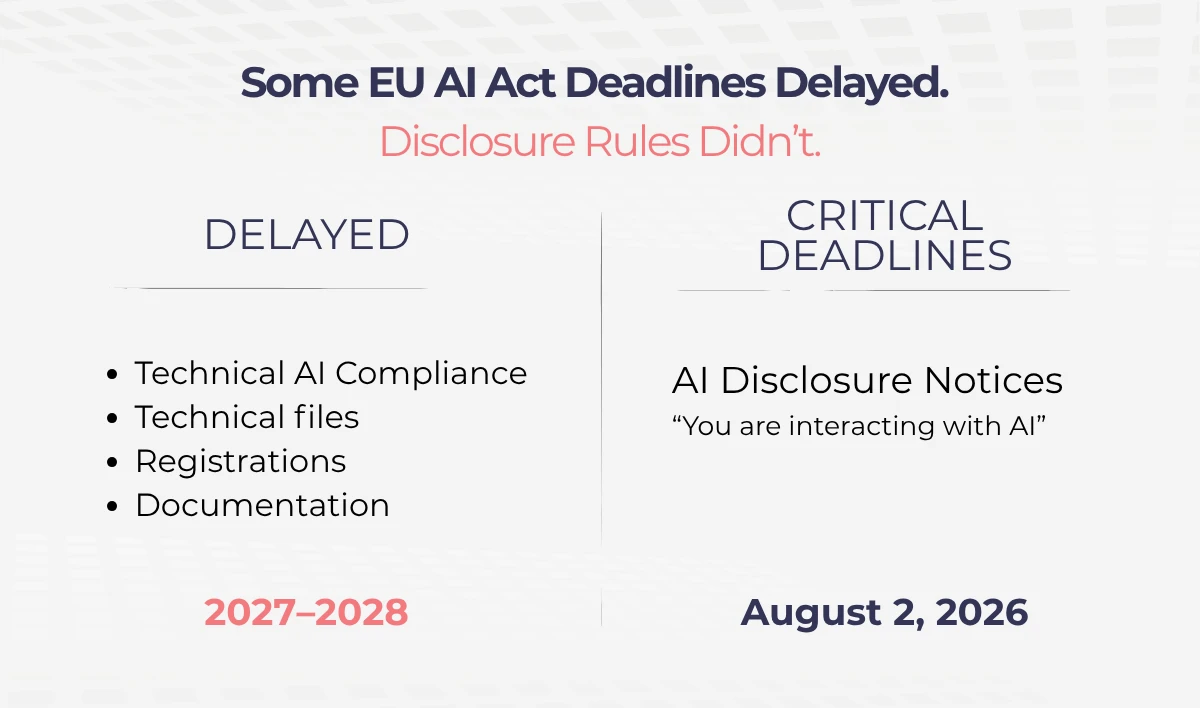
Most life science companies tracking the EU AI Act amendments have been focused on the high-risk AI documentation requirements, the technical files, instructions for use, and database registrations. In April, those deadlines were pushed back to 2027 and 2028.
What did not move was the August 2, 2026 deadline.
That is the date by which any medical AI system that interacts directly with people, patients, clinicians, or trial participants must clearly inform them they are talking to AI, not a human. No exceptions for the sector. No extension for life science companies.
The EU AI disclosure amendments requirement for life science companies applies across every EU market where these AI tools are deployed, especially for patient-facing systems using natural language interactions.
On May 8, the European Commission published draft guidelines clarifying exactly what these disclosures must say and how they must appear. The consultation closes June 3. Final guidelines will follow shortly after.
That leaves less than three months to get disclosure notices written, translated, and live across every EU market where an affected tool is deployed.
What the EU AI Act Amendments Actually Require
From August 2, 2026, if your company deploys an AI system that interacts with people, those people must be told they are interacting with AI, not a human. The disclosure must appear at the first point of interaction, in a clear and accessible format.
“Clear and accessible” means in a language the user understands. In the EU, that means the official language of the country where the tool is being used.
This applies whether your company built the AI tool or is using one built by a vendor. Both the developer and the deployer carry obligations under the law.
Source: Article 50, EU AI Act | Full regulation text, EUR-Lex
Which Life Science AI Tools Fall Under the Rule
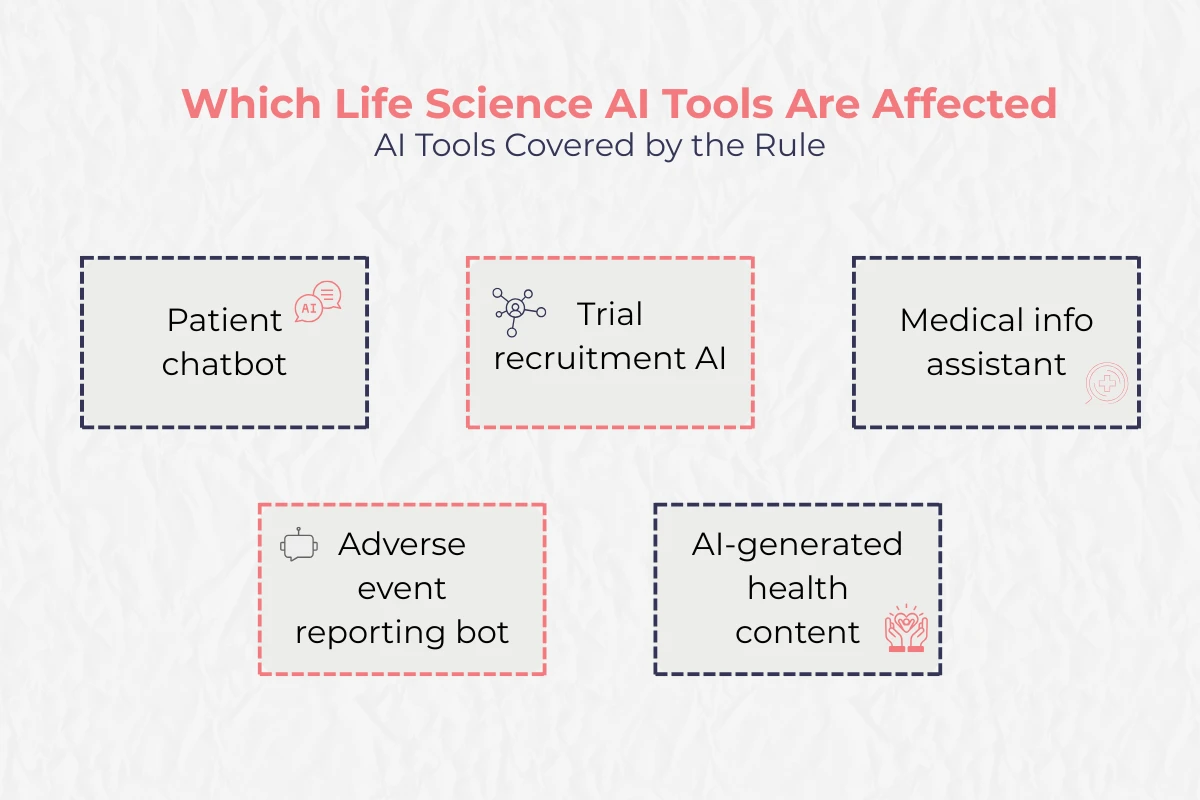
This is not about all AI. It covers AI that interacts with or generates content for people. In life sciences, that includes:
1. Patient chatbots and virtual assistants:
Appointment booking tools, symptom checkers, medication reminder systems, and patient adherence platforms all qualify. If the tool uses natural language to communicate with a patient, it is in scope.
2. Clinical trial recruitment tools:
AI that screens candidates, answers eligibility questions, or communicates with potential participants must carry a disclosure. Companies like Bayer and Sanofi are already running AI driven trial recruitment across multiple EU markets. Life science companies already navigating EU regulatory translation requirements for life sciences under the EU CTR will recognise the same language-specific compliance logic the expectation for clear, local-language documentation is consistent across EU life sciences regulation.
3. Medical information platforms:
Any AI that responds to questions from patients or healthcare professionals, via a web interface, app, or messaging platform, is covered.
4. Adverse event reporting bots:
AI that collects safety reports from patients or field staff through conversational interfaces falls under the same obligation.
5. AI-generated health content:
Patient letters, summaries, or public health information produced by AI and published without genuine human editorial review must be disclosed as AI-generated.
What is not affected:
AI used purely internally, or AI whose non-human nature is obvious from context. A robotic sorting system in a manufacturing facility does not need a disclosure. A patient-facing chatbot using natural language does, even if it has a bot icon.
Three Steps to Meet EU AI Disclosure Requirements Before August 2
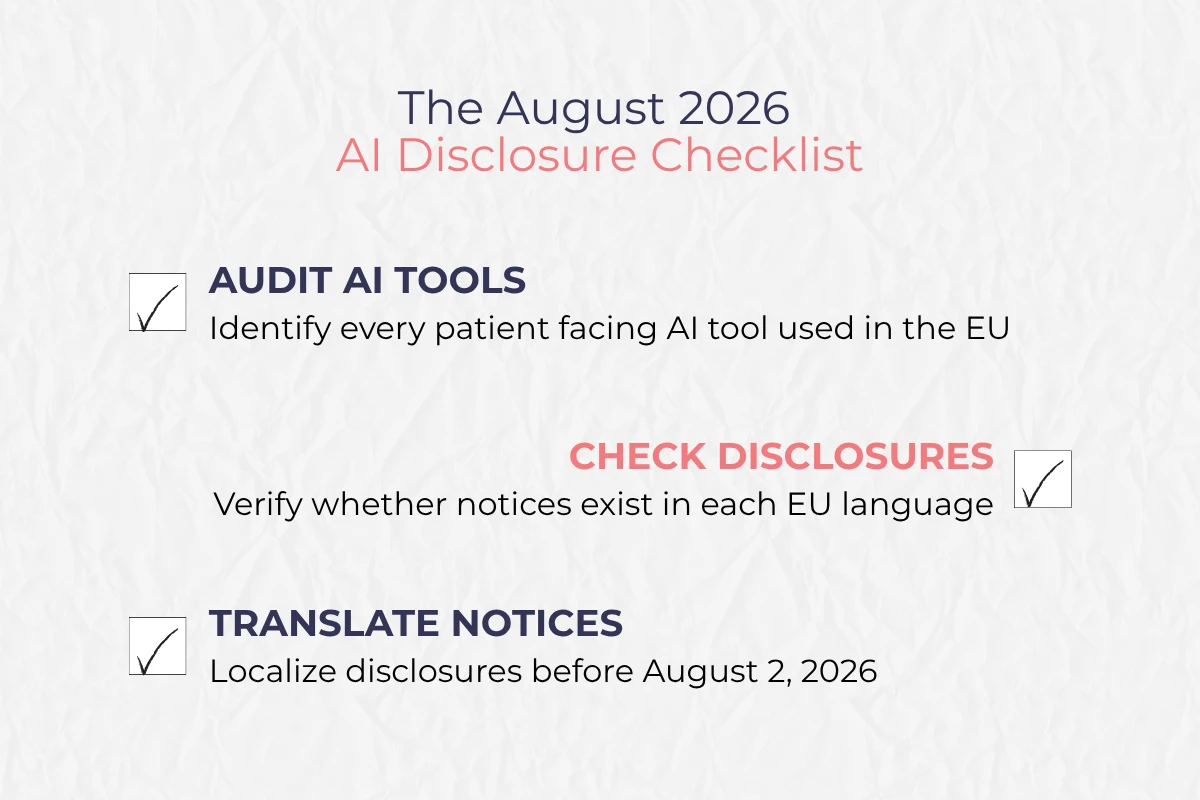
Three steps. Each is straightforward.
Step 1: List every AI tool your company deploys that interacts with patients, clinicians, or trial participants in the EU. If it communicates using natural language, voice, or text, it is likely in scope.
Step 2: Check whether a disclosure notice already exists in each EU market where the tool is live. If the notice exists only in English, it does not meet the requirement for non-English-speaking markets.
Step 3: Get the notices translated before August 2. This is not a complex translation job. It is a short, precise one. The risk is not volume, it is accuracy. A notice that sounds clumsy or technically incorrect in German or Polish will undermine patient trust and attract regulatory scrutiny.
The Consultation Is Still Open
The draft guidelines published May 8 are open for stakeholder feedback until June 3, 2026. If your company uses AI tools in grey-area situations, for example, AI that assists a human clinician rather than directly interacting with a patient, this consultation is worth engaging with. The final guidelines will carry significant weight when regulators assess compliance.
Submit feedback to the European Commission here
Conclusion
August 2, 2026 is firm. Unlike the broader high-risk AI documentation requirements, this deadline was not extended.
The translation task is small in volume but high in consequence. A poorly translated or missing disclosure notice in a clinical setting is both a compliance failure and a patient communication failure.
Milestone Localization has supported regulated translation for life science companies across EU markets for over two decades. If you need disclosure notices translated before the August deadline, get in touch.
Stay compliant with localized AI disclosures.
FAQs
What are the EU AI disclosure requirement life science companies?
The EU AI Act requires life science companies to clearly inform users when they are interacting with AI systems instead of humans.
Which life science AI tools are affected by the EU AI Act?
Patient chatbots, clinical trial recruitment tools, medical information assistants, adverse event reporting bots, and AI-generated patient content may all fall under the disclosure requirements.
Do AI disclosure notices need translation for every EU country?
Yes. The disclosure must appear in a language the user understands, which means companies need localized notices for each EU market where the AI tool is deployed.
Does an English-only AI disclosure meet EU requirements?
No. An English-only notice is generally not sufficient for non-English-speaking EU markets.
What happens if companies fail to comply?
Non-compliance can result in penalties of up to €7.5 million or 1% of annual global turnover under the EU AI Act.
Are internal AI systems covered by these disclosure rules?
No. AI systems used purely internally without direct interaction with patients, clinicians, or trial participants are generally not affected.
Why is accurate localization important for AI disclosures?
Poorly translated disclosures can create confusion, reduce patient trust, and increase regulatory risk in clinical and healthcare settings.
How can life science companies prepare for the deadline?
Companies should identify affected AI tools, review existing disclosures across EU markets, and localize notices before August 2, 2026.