
That effort is visible, deadline-driven, and budgeted. What comes after is far less visible and far more frequently underestimated. It shifts from a one-time project to a constant operational demand.
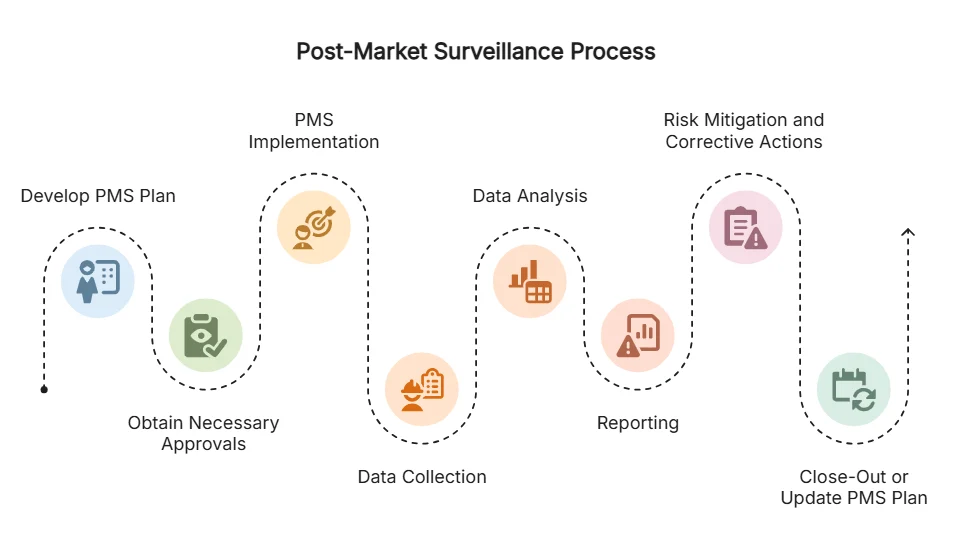
Post-market surveillance (PMS) under EU MDR is a continuous, lifecycle-long obligation. It generates a substantial body of regulated documentation, and every document in that body carries language requirements that don’t pause between updates.
For manufacturers selling across multiple EU markets, the translation workload tied to EU MDR post-market surveillance can rival the complexity of pre-market translation.
What Is Post-Market Surveillance Under EU MDR?
Post-market surveillance is the systematic, proactive collection and analysis of real-world data on a device’s safety and performance once it has entered the market.
It is governed by Articles 83–92 of EU MDR 2017/745. The most current operational guidance is set out in MDCG 2025-10, published in December 2025.
PMS is often conflated with vigilance (mandatory incident reporting) or market surveillance (the competent authority’s oversight function). In practice, PMS is part of the manufacturer’s Quality Management System, and the manufacturer is responsible for designing, implementing, and maintaining it.
The device’s risk class determines how detailed the documentation must be. No device class escapes the obligation entirely.
Also Read: MDD vs MDR: Key Differences in Translation
The Documents That Carry a Translation Obligation
Under EU MDR, PMS generates six categories of documentation, each with distinct language requirements:
| Document | Device Class | Update Frequency | Translation Obligation |
| PMS Plan | All classes | As needed | Available to competent authorities on request |
| PMSR (Post-Market Surveillance Report) | Class I | As needed | Official language of the requesting authority |
| PSUR (Periodic Safety Update Report) | Class IIa, IIb, III | Annually (IIb/III); every 2 years (IIa) | Submitted via EUDAMED for higher-risk devices |
| SSCP (Summary of Safety and Clinical Performance) | Class III + implantables | At least annually | All 24 EU official languages; publicly visible on EUDAMED |
| PMCF Plan & Report | All classes | Annually | Reviewed by notified bodies; feeds into SSCP |
| Field Safety Notices (FSNs) | All classes | As incidents occur | Time-critical; must reach end users in their language |
The SSCP is the document that catches most manufacturers off guard.
Publishing a Summary of Safety and Clinical Performance in all 24 official EU languages is not a one-time event. It must be updated at least annually, and every update must be reflected across all language versions simultaneously.
A single SSCP update that reaches 18 of 24 language versions before the renewal deadline is not partial compliance. It is non-compliance in the missing six markets.
Also Read: EUDAMED Translation Requirements for Medical Device Manufacturers
Why PMS Translation Is a Different Kind of Problem
Pre-market translation operates on predictable timelines. You know when regulatory submissions are due. You can build translation into the project plan months in advance.
Post-market surveillance translation operates on a different logic entirely.

Speed is a constraint:
Field Safety Notices may need to be translated and distributed within days of a safety signal being confirmed. A linguist who has never encountered your device’s terminology before is a liability at that moment. An LSP with a pre-built, validated glossary and an established FSN workflow is an asset.
Version control is continuous:
Every PSUR update triggers a requirement to refresh the SSCP, which triggers a requirement to update 24 language versions. Without an automated link between your regulatory calendar and your translation pipeline, version gaps accumulate silently until an audit or EUDAMED inconsistency surfaces them.
Visibility has changed:
EUDAMED’s four mandatory modules go live on 28 May 2026, with vigilance and PMS modules to follow. PSURs, SSCPs, and FSNs will be accessible to regulators, healthcare professionals, and the public. A translation inconsistency that once lived inside a technical file now lives on a publicly searchable database.
The audience is dual:
The SSCP contains a technical section for healthcare professionals and a plain-language section for patients. That plain-language section must be drafted carefully before translation begins, not produced by asking a linguist to simplify clinical text in 24 languages simultaneously.
Common PMS Translation Pitfalls, and Why They Happen
The most frequent failures in post-market surveillance translation follow recognisable patterns.
Delayed SSCP updates after PSUR publication. The PSUR and SSCP are linked documents. Manufacturers who treat them as separate workflows, with separate translation timelines, routinely create version gaps that are visible to notified bodies and, increasingly, to EUDAMED users.
Terminology mismatches across document types. The same device, indication, or adverse event described in different terms across the PSUR, SSCP, and FSN is not merely an inconsistency; it is an audit finding.
Plain-language failures in patient-facing sections. Translating a SSCP patient section written in a clinical register is not translation. It is compounding a source problem. Plain-language drafting belongs before translation begins.
FSNs translated without an established infrastructure. A Field Safety Notice dispatched to 15 markets through 15 separate translation requests, without shared glossaries or QA protocols, is a regulatory and communications liability.
No trigger linking regulatory updates to translation workflows. Manufacturers who rely on manual processes to flag when a document update requires translation will miss updates. PMS translation management needs to be built into the QMS, not managed through email threads.
Best Practices for Managing PMS Translation Across the Device Lifecycle
Build a PMS translation matrix before you launch. Map each document category to its language obligations, update frequency, and responsible owner. A matrix built at market entry is significantly easier to maintain than a retrospective audit of what was and wasn’t translated.
Establish your terminology database from the start. The terms used in your IFU, clinical evaluation report, and labelling should carry directly into your PMS documents. Terminology continuity across the device lifecycle is the infrastructure that prevents mismatches from multiplying across languages.
Treat SSCP translation as a standing annual obligation. Plan for a 90-day update window following each PSUR publication. That window should include SSCP revision, plain-language review, translation briefing, translation, QA, and EUDAMED upload, in that order, with time allocated to each stage.

Centralise PMS translation with a single language service provider. Fragmented translation across multiple vendors introduces terminology inconsistency, version control risk, and audit vulnerability. A single LSP with your complete terminology database and a validated QMS aligned to ISO 13485 provides the consistency that PMS documentation demands.
Apply publication-quality standards to all public-facing documents now. EUDAMED visibility is not a future consideration, it is an operational reality as of 2026. SSCPs and FSNs will be read by healthcare professionals and patients. Preparation standards should match the audience.
Also Read: Proposed Changes to EU MDR and IVDR
What to Look for in a Translation Partner for PMS Documentation
Not every medical translation provider is equipped for EU MDR post-market surveillance work. The distinction matters.
A capable PMS translation partner should demonstrate:
- Substantive knowledge of EU MDR and IVDR regulatory requirements, not general healthcare translation experience, but regulatory document expertise specifically
- An ISO 13485-aligned QMS with validated terminology management and version control processes
- Linguists with regulatory affairs backgrounds who understand the compliance context of the documents they are translating
- Established FSN workflows capable of delivering time-critical translations without compromising quality
- Experience with SSCP plain-language patient sections, including the ability to advise on source text quality before translation begins
- GDPR-compliant infrastructure for handling sensitive device and clinical data
Milestone Localization specialises in regulatory translation for medical device manufacturers navigating EU MDR compliance, with dedicated workflows for SSCP, PSUR, and FSN documentation.
Conclusion
Manufacturers who build post-market surveillance translation into their PMS system from the start, with a translation matrix, a validated terminology database, a standing SSCP update schedule, and a centralised LSP will hold up under inspection and scale as their device portfolio grows.
Milestone Localization works with medical device manufacturers throughout the EU MDR compliance lifecycle. For guidance on building a PMS translation framework for your device portfolio, contact our regulatory translation team.
FAQs
What translation obligations do post-market surveillance documents carry under EU MDR?
EU MDR generates six categories of PMS documentation with distinct language requirements. The SSCP must be published in all 24 official EU languages simultaneously.
PSURs are submitted via EUDAMED. FSNs must reach end users in their own language within days of a confirmed safety signal. PMS Plans and PMSRs must be available in the official language of any competent authority that requests them.
How often must the SSCP be updated and translated?
The SSCP must be updated at least annually for Class III and implantable devices, and every update must be reflected across all 24 EU official language versions at the same time. A partial upload, reaching some but not all languages before the renewal deadline, constitutes non-compliance in the missing markets.
What makes PMS translation different from pre-market translation?
Pre-market translation is deadline-driven and predictable. PMS translation is continuous and reactive. FSNs require translation within days, not weeks. SSCP updates trigger simultaneous 24-language obligations annually.
EUDAMED makes PMS documents publicly visible, meaning a translation inconsistency is no longer confined to a technical file, it is searchable by regulators, healthcare professionals, and patients.
What is the SSCP, and why does it require plain-language drafting before translation?
The Summary of Safety and Clinical Performance (SSCP) is required for all Class III and implantable medical devices under MDR Article 32. It contains a technical section for healthcare professionals and a plain-language section for patients.
The patient-facing section must be written clearly in the source language before translation begins. Asking linguists to simplify clinical text across 24 languages simultaneously compounds a source authoring problem and produces inconsistent results.
How should manufacturers manage FSN translation when speed is critical?
Field Safety Notices require a pre-established translation infrastructure, not an ad-hoc process. Manufacturers should work with an LSP that holds a validated device-specific glossary, a tested FSN workflow, and the capacity to turn around translations in multiple languages within 24–72 hours. Fragmented FSN translation across multiple vendors, without shared terminology or QA protocols, is a regulatory and patient-safety liability.