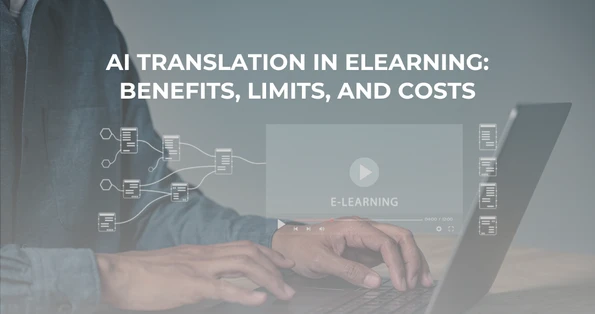
The global eLearning market reached $325 billion in 2025 and is projected to reach $665 billion by 2031. Over 93% of businesses now plan to use eLearning as a primary training channel.
Yet most organizations still create training in a single language, usually English, and deliver it to teams that speak many others. This gap has pushed teams toward AI translation as a quick fix. Many adopt it without fully understanding its limits.
This blog explains how AI translation in eLearning works, where it fits, where it fails, and how it affects learners.
What is AI Translation for eLearning?
AI translation uses neural machine translation (NMT) and large language models (LLMs) to convert content into different languages. Tools like DeepL, Google Translate API, and GPT-based platforms make this fast and scalable.
That speed is why many L&D teams rely on it. It allows them to push courses into multiple languages without rebuilding content from scratch.
The issue is that eLearning content is not static. A course needs to guide, explain, and hold attention. Language plays an active role in that process.
When translation feels unnatural, learners shift their focus from learning to figuring out what the content means. This breaks the experience.
AI translation still gets applied across the full course:
- On-screen text: instructions, objectives, quizzes
- Subtitles: translated video captions
- Audio narration: AI-generated voiceovers
- UI elements: buttons and navigation
- AI-generated videos: used to visually present lessons and support better understanding through dynamic content. AI-generated videos: used to visually present lessons and support better understanding through dynamic content. Before publishing these materials, organizations should also check for signs of manipulation to ensure the videos are authentic and appropriate for learners.
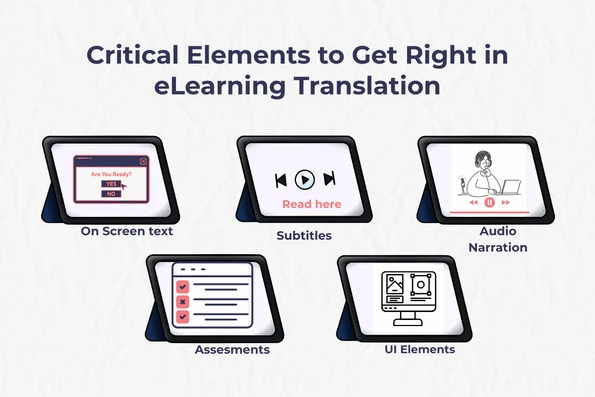
Each layer has a different tolerance for error. A small issue in navigation may not matter. The same issue in a quiz or compliance module can affect understanding.
Also Read: Everything About Multilingual Subtitles for eLearning Videos
When Does AI Translation Work Well?
AI translation in eLearning performs well in environments where clarity matters more than nuance.
1: Procedural and technical content
Step-by-step guides, system walkthroughs, and product instructions translate well because they rely on direct language.
2: High-resource language pairs
Languages like Spanish, French, German, and Mandarin benefit from stronger training data. Output quality tends to be more reliable.
3: Draft creation for human review
AI can generate a first version quickly. Human translators can then refine tone, terminology, and clarity.
4: Frequently updated content
Courses that change often, such as product updates or internal tools, benefit from AI’s speed. Manual retranslation for every update slows teams down.
5: Market testing
Organizations entering new regions can use AI to validate demand before investing in full localization.
In these cases, AI helps teams move faster and manage costs without significantly affecting learner outcomes.
Where AI Translation Struggles
Problems start when teams use AI translation in areas that require judgment, context, or precision.
1: Cultural context
AI translates words directly. It does not adapt meaning to cultural expectations. Idioms, humour, and references often lose their intent.
2: Domain-specific terminology
Industries like healthcare, legal, and manufacturing depend on precise language. Generic models often misinterpret specialised terms. This isn’t limited to translation. The same pattern shows up anywhere models handle dense, industry specific language. Claude RFP limitations have been documented in enterprise proposal responses, where generic models struggle to interpret precise technical and legal terminology correctly.
3: Low-resource languages
Languages with limited training data show weaker results. This includes many South Asian, Southeast Asian, and African languages.
4: Right-to-left languages
Arabic, Hebrew, and Urdu require layout changes, not just text translation. AI tools rarely handle this correctly.
5: Assessment accuracy
A poorly translated question can change what a learner understands and how they respond. This affects evaluation quality, particularly when educators grade essays with AI or rely on automated assessment systems to measure learner performance.
6: Emotion-driven content
Leadership training, soft skills modules, POSH training and DEI programmes rely on tone and nuance. AI-generated text often feels flat and disconnected. Learners and reviewers can often sense this flatness because AI writing tends to repeat certain wording patterns. The phrases and patterns ai detectors flag most covers the exact expressions that give AI content away, which is useful to review before finalising any translated course material.
7: AI voiceover limitations
Synthetic voices lack natural pacing, emotional variation, and accurate pronunciation for names or local terms. Learners often notice this immediately
Looking for eLearning translation services?
What It Actually Costs Your Learners
AI translation reduces production cost but shifts the impact onto the learner experience.
1: Comprehension gaps:
Unclear or awkward phrasing forces learners to interpret meaning on their own. This slows learning and increases mistakes.
2: Lower engagement
Learners disengage when content feels unnatural or difficult to follow. Poor narration makes this worse.
3: Loss of trust
A single visible error can reduce confidence in the entire course. Learners start questioning the accuracy of the content.
4: Drop in completion rates
Disengaged learners are less likely to finish training. This directly affects programme effectiveness.
5: Operational risk
In compliance or safety training, incorrect translation can lead to real-world consequences. This extends beyond learning into business risk.
Also Read: eLearning Translation: How to Make Learning International
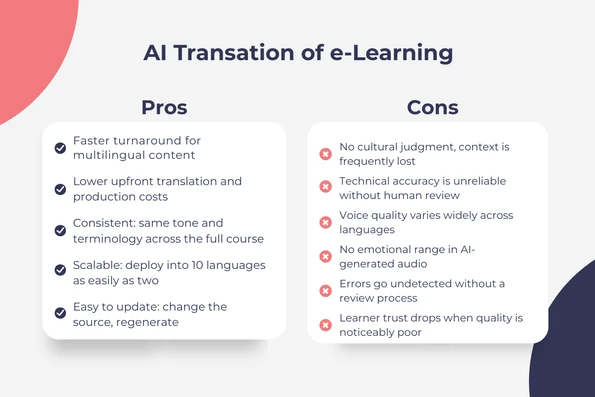
What You Gain and What You Risk
The benefits of AI translation are visible in your workflow. The limitations show up in your learners’ experience. Understanding both helps you make better decisions.
The Right Approach: Human-led, AI-assisted
AI translation works best when used as part of a broader workflow.
Use AI for:
- Neutral, instructional voiceover
- Text embedded in visuals and UI elements
- Low-impact content such as FAQs and navigation
Use human expertise for:
- Course scripts and storytelling elements
- Assessments and feedback
- Compliance and safety content
- Any content where tone, clarity, or context affects learning
A combined approach improves both efficiency and quality. AI handles scale and speed. Humans ensure accuracy and relevance.
Also Read: Top 8 eLearning Translation Companies in 2025
Conclusion
AI translation can support eLearning teams when used in the right context. It speeds up production and reduces operational effort.
Used without oversight, it creates gaps in understanding, engagement, and trust. Those gaps affect how learners experience and complete training.
The decision comes down to fit. Use AI where it performs well. Bring in human expertise where it matters most.
Are you looking for certified eLearning translation services?
FAQs
When should you use AI translation for eLearning courses?
Use it for procedural content, product walkthroughs, and courses that update frequently. It also works well as a first draft that a human reviewer refines. Avoid using it as a final output for anything that affects learner evaluation or compliance.
What is AI translation for eLearning?
It uses neural machine translation (NMT) and large language models to convert course content into other languages. It covers on-screen text, subtitles, voiceovers, UI elements, and assessments. It is fast and scalable, but it does not replace human judgment on context and tone.
How does AI translation affect eLearning completion rates?
Unnatural phrasing and flat narration push learners to disengage. Disengaged learners are less likely to finish training. For business-critical courses, this is a measurable risk, not just a quality concern.
Does AI translation work for low-resource languages in eLearning?
Results are weaker for South Asian, Southeast Asian, and African languages due to limited training data. For learners in these regions, human-led localization produces more accurate and culturally relevant output.
What is the best approach for multilingual eLearning content?
Use AI for instructional text, UI elements, and low-stakes content. Use human translators for scripts, assessments, and compliance content. The two work best together, not as substitutes for each other.