
Every reliable healthcare provider should offer their multilingual patients the best possible services, regardless of language.
Healthcare translation services can be extremely beneficial for anyone in the healthcare sector, who wants to ensure effective communication with all their patients.
Medical translation is the process of transferring medical texts, such as technical documents, clinical drug information, patient history, illness worksheets, etc., from the source language to the target language.
Oftentimes, medical translation is a legal requirement if healthcare providers work with multilingual patients and stakeholders.
The process of medical translation, on the other hand, is highly regulated. Medical translators receive special training and professional certification, which allows them to successfully practice their profession.
Also read : Professional document translation service.

Medical translators are well-trained and experienced in their working languages and medical terminology. Only in this way, they can ensure that they can produce quality translations that fully adhere to the medical terminology.
In addition, medical translation is crucial since it can prevent miscommunication between healthcare workers and patients.
If you want to learn more about the benefits of medical translation as well as the process itself, keep reading. In this blog, you can find all the information you will ever need!
Language barriers in healthcare
Language barriers usually occur between healthcare workers and their patients when both of them do not share a common native language.
What’s more, language barriers in healthcare have major consequences for the efficiency and quality of medical services. In most cases, due to linguistic differences, misunderstandings might occur between both sides. What’s even worse, such miscommunications can have fatal consequences.
Indeed, equality among all patients regardless of language is a human right that every healthcare provider should deliver.
Several studies in this regard have shown some worrying tendencies.

A recent study, for example, has demonstrated that patients who need to be more fluent in the local language are at a massive disadvantage when it comes to accessing healthcare services.
Several studies have found that patients who speak the local language have much better health conditions compared to patients who are faced with language barriers.
A study conducted in six US hospitals found that patients with limited proficiency in English are much more likely to experience adverse events.
Such studies shed some light on the fact that language barriers have an indirect impact on the quality of the healthcare services that patients receive. This in turn is a clear sign that healthcare providers should concentrate their efforts on providing excellent services despite language barriers.
Also read: Medical Translation Agency : How To Choose The Right One
Importance of accurate and efficient healthcare translation
Accurate and efficient healthcare translation can have huge benefits for both patients and healthcare providers.

Improved patients’ health and lower death rate
When the healthcare translation is performed professionally and accurately, it can save lives.
Professional medical translators know how to safeguard the well-being of patients. In other words, they have detailed medical knowledge and can handle different situations in which different levels of understanding are required.
More international patients
A lot of people travel abroad to receive medical treatments which are too expensive in their homeland or simply are not provided.
Medical tourism, as many call this occurrence, is common in both developed and underdeveloped countries. Healthcare translation, on the other hand, could be greatly beneficial to draw more clients from various countries.
For example, those in fields like obstetrics and gynecology must understand everything about OBGYN medical billing. Healthcare translation ensures they can effectively translate and communicate all the billing details to international patients seeking those services, contributing to a more wholesome and stress-free healthcare experience.
Also read: The Right Way To Do Medical Translation

Also read: ICF Translation: Importance, Requirements & Best Practices
Minimized legal risks
The medical translation must be accurate. To ensure that even the smallest detail is taken into account, the output is verified numerous times.
In this way, one can be sure that all the information is properly translated, and even if accidents occur, they won’t be due to miscommunication between patients and doctors.
For example, accuracy is especially important in the context of translating Electronic Health Records (EHRs) for specialized fields such as nephrology.
In combination with EHR solutions and health app development catering for nephrologists, professional translation services can provide peace of mind when dealing with patient information that’s in a non-native language, and which uses technical terminology that cannot be left open to interpretation.
Challenges in healthcare translation
While medical software translation can be greatly beneficial, it can also be quite challenging. Therefore, medical translators are well-trained so that they can handle every obstacle that they stumble upon during the translation project.

Medical terminology and language
Medical terms vary across different healthcare-related domains, such as medicine, diseases, and health conditions.
What’s more, many of these terms stem from Latin and Greek, so a medical translator is required to be fluent in both of these languages as well.

A good medical translator is a core subject-matter expert and, thus, can find the proper equivalents of each term in the target language.
To acquire such a skill, a medical translator needs to be highly proficient in their working languages. In addition, they have to have proper medical experience in the specified medical sector.
Also read: Medical Document Translation : 5 Simple Ways For Quality Assurance
Abbreviations and word compounding
The medical field is notorious known, not only for its complicated terminology but also for its numerous abbreviations and acronyms.
These are quite challenging since some have already established translations, but there are always exceptions. In such cases, the translator has to come up with the translation themselves.
On the other hand, compound nominal phrases are quite common in the English language. For example, heart failure, contrast medium, and patient safety are pretty common terms that, when translated into another language, might undergo certain changes.
Eponyms
Another big group of medical terms related to human anatomy, medical tools, diseases, symptoms, signs, or even medical procedures is eponyms. The most common examples include Parkinson’s disease, Alzheimer’s disease, and more.
Adapting to the target audience
Medical translators are often faced with the challenge of adapting their output to the target audience.
For instance, sometimes a highly specialized medical text needs to be translated and adapted for a general audience. This entails the adaptation of the specialized medical terms to the needs of the reader. Sometimes additional explanations are required, or certain terms are replaced with more common concepts.
In some other cases, however, the target audience is medical specialists, and thus, the translator needs to stick to the medical terminology.
Also read: Localization & Translation Costs : Breakdown Of Factors Involved
Get your medical documents translated from experts
We provide high-quality medical translation services in Chinese, Japanese, Hindi, and 70+ languages.
Methods of healthcare translation currently in use
Machine translation is rarely used in healthcare translation since it does not provide accurate output. Non-creative texts, such as technical manuals, are among the few medical texts that can be translated with MT.
What’s more, this technology, when used on its own, despite the short delivery time and low costs, does not take into consideration any culturally relevant factors. What’s a big advantage of MT is the fact that it can handle big quantities of data very fast.

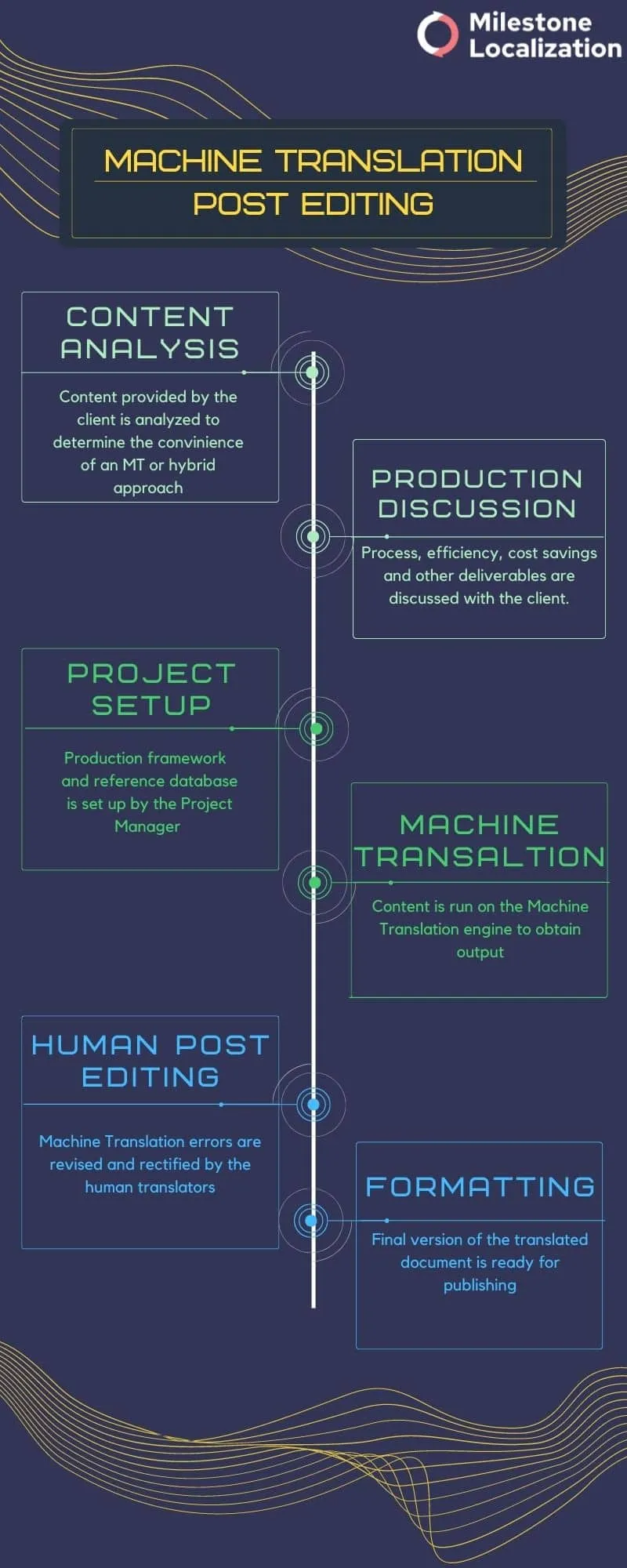
Machine translation and human post-editing, however, is a much more reliable translation method. This combination of human and machine translation offers reduced costs and delivery times (compared to only human translation).
The way it works is simple: the medical text is translated with an MT engine, and the output is edited by a human translator. In this way, accuracy and precision are ensured.
This translation method is suitable for non-creative texts, such as technical manuals and brochures.
Also read: Machine Translation Post Editing: Everything You Need To Know
Human translation is the most common translation method in the medical sphere because it is accurate. No machine can catch the subtle nuances of meaning as well as a human translator can.
What’s more, human translators can effectively choose the right terminology depending on the context. They can very successfully adapt the content to the needs of the target audience as well.
Of course, all this comes at a higher price and with longer delivery times.
Interpretation is the act of translating speech at the moment of speaking. Again, it is performed only by human translators, and due to the complexity of the job, it is very highly paid.
Lastly, transcreation is another translation method that is performed by human translators and is a highly creative procedure.
Transcreation is the process of adapting the content, including text, images, graphs, color schemes, etc., to the cultural understanding of the target audience. It is usually used for marketing content, such as brochures, websites, and social media content.
Transcreation services require a lot of experts, such as translators, graph designers, etc., to work together to deliver a project. Thus, prices and delivery times are higher than those of most other translation services.
Also read: Top Qualities Of A Good Translation
Disadvantages of machine translation & current solutions for healthcare translation
Machine translation is fast and cheap, yet it does not produce accurate output. Thus, it should be avoided at all costs, especially in domains such as medical translation, where even the smallest error can have fatal consequences.
Nevertheless, the advantages of MT (lower costs and shorter delivery times) cannot be denied, and thus, experts have found certain solutions that can help integrate this translation method into the medical translation industry.
On one hand, MT post-editing is a service that is becoming increasingly common. The MT output is edited by a human translator, who ensures that all the requirements of the client are fulfilled.
At the same time, CAT (Computer Assisted Translation) tools aid human translators in the translation process. These systems are equipped with terminology databases, which help translators find terms quickly and easily; translation memories (TM), which store previous translations that can be reused later to save time and costs; and integrated machine translation, which can help translators handle projects faster and more efficiently. Teams creating specialized translation platforms can compare AI SaaS building tools for terminology databases, review workflows, and access controls

Conclusion
Medical translation is crucial when it comes to preserving and enhancing human life. Indeed, it can provide easy and reliable access to healthcare for everyone, regardless of their location and language.
However, medical translation requires accuracy and specialized knowledge of the working languages and medical terminology. The tiniest translation error can have life-threatening consequences, so working with a professional translation agency is always a must.
Also read: Top 10 Translation Companies In India
Get your medical documents translated from experts
We provide high-quality medical translation services in Chinese, Japanese, Hindi, and 70+ languages.