
The cost of translation depends as much on the pricing model as it does on the content itself. One translator may charge per word, another may charge per page, and an agency may calculate part of the project by the hour.
These pricing models serve different purposes. Per-word pricing works well for most documents and large volumes of content. Per-page pricing often suits certificates and official records. Hourly pricing covers compound, creative or review tasks.
In this guide, we explain how each model works, what affects translation rates, and how to compare quotes with confidence.
Why Translation Pricing Varies
The translation industry has no fixed global rate. Providers calculate prices according to the work, expertise, and quality process involved.
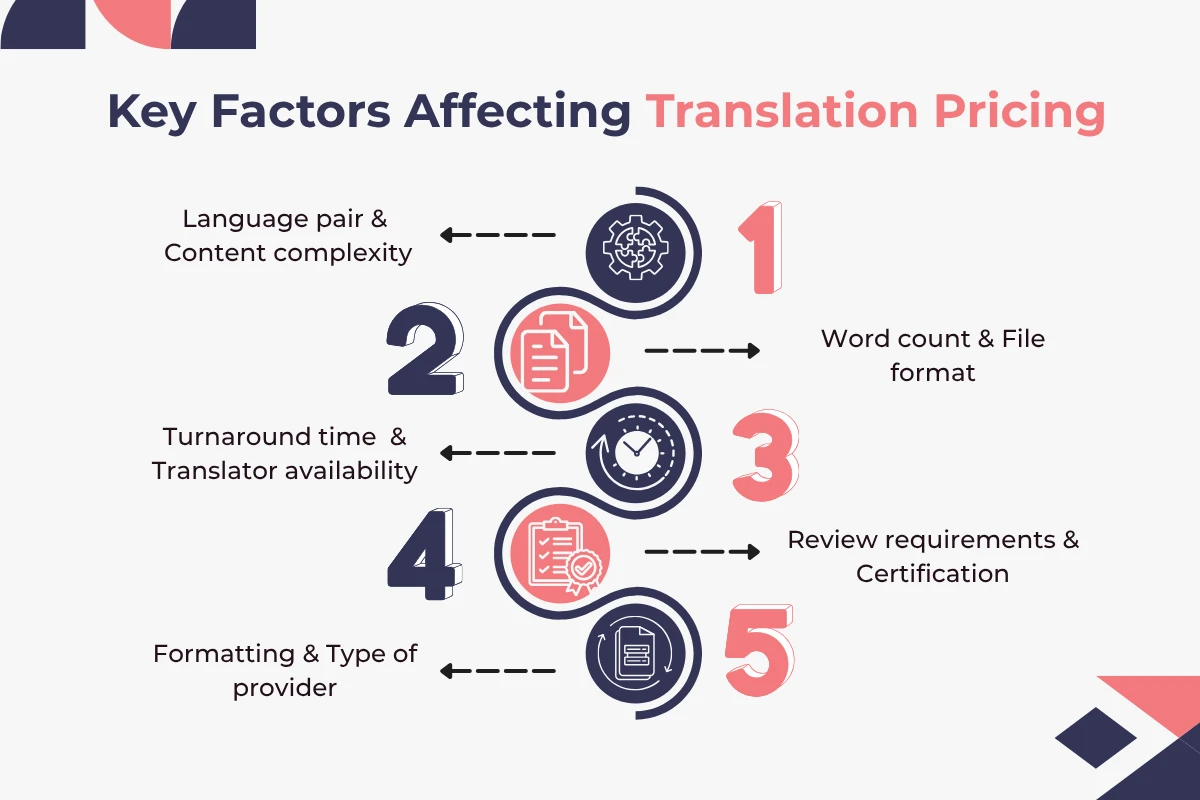
The main pricing factors include:
Common language pairs usually cost less because more qualified translators can handle them. Rare language pairs often attract higher rates.
Specialized content also costs more. Legal contracts, medical documents, and technical manuals require subject expertise and careful terminology management. Errors in these fields can create financial, legal, or safety risks.
Freelancers, agencies, and AI-assisted services follow different pricing structures. An agency quote may include project management, independent editing, quality checks, and technical support.
Per-Word Pricing
Per-word pricing remains the most common model for documents, websites, marketing materials, product information, and technical content.
The calculation looks like this:
Word count × rate per word = translation cost
A 5,000-word document quoted at $0.12 per word would cost $600 before any additional services.
Providers may calculate the price using the source text or translated text. Source-word pricing gives buyers a confirmed word count before work begins. Target-word pricing can change the final total because some languages expand during translation.
What is a Reasonable Translation Rate Per Word?
Broad 2026 market estimates place professional translation rates at around $0.04 to $0.30 per word. General content in a common language pair may fall near the lower end. Legal, medical, technical, or creative translation usually costs more.
A reasonable rate should reflect the complete service. Depending on the quote, it may include:
- Translation by a qualified linguist
- Terminology research
- Editing or proofreading
- Automated quality checks
- Basic formatting
- Project management
- Agreed revisions
- Certification
A low rate may cover translation without independent review or rely heavily on unedited machine output. Compare the included services before comparing prices.
Translation Memory Discounts
Translation memory software stores approved translations and identifies repeated or similar sentences. It helps translators reuse previous work and maintain consistent terminology.
Providers may separate the word count into:
- New words
- Repeated words
- Exact matches
- Partial matches
Repeated content and strong matches may receive discounted rates. Translators still review these segments in context, so a match does not always mean zero cost.
This pricing model can reduce costs for technical manuals, product catalogues, software, and regularly updated content.
Also Read: Terminology management for life sciences: Why translation memory alone isn’t enough
Get a Translation Quote Based on Your Project.
Per-Page Pricing
Per-page pricing commonly applies to certificates, academic records, immigration paperwork, and other short official documents.
A “page” may refer to a standard number of words rather than one physical sheet. Some providers define a standard page as 250 words, while others use 300 words or a fixed character count.
Per-page rates generally range from $10 to $75. The language pair, document type, certification, and formatting requirements determine the final price.
Documents may cost more when they contain:
- Handwritten text
- Stamps or seals
- Complex tables
- Poor-quality scans
- Dense text
- Certification requirements
Pros and Cons of Per-Page Pricing
Per-page pricing gives buyers a quick, predictable cost for short documents. It also works well when counting the source words would take more time than reviewing the file manually.
The definition of a page can create confusion. A lightly written certificate and a dense legal page require different amounts of work.
Before accepting a quote, confirm:
- How the provider defines one page
- Whether certification comes with the price
- Whether the service includes formatting
- How the provider handles stamps and handwriting
Per-Hour Pricing
Providers use hourly pricing when word count does not reflect the work involved. It commonly applies to:
- Editing and proofreading
- Linguistic review
- Desktop publishing
- Consulting
- Terminology work
- Quality assurance
- Transcreation
- Localization testing
General market estimates place many translation-related hourly rates between $15 and $50 or more. Experience, specialization, location, and task type affect the rate.
How Much Should I Charge for Translation Per Hour?
Freelancers often calculate their hourly rate using productivity and operating costs. Buyers can use the same logic to understand a quote.
For example, a translator who handles 400 words per hour at $0.15 per word generates a base figure of $60 per hour. The final rate may also account for research, administration, software, taxes, and non-billable time.
Hourly pricing suits work that depends on judgment rather than volume. A short marketing tagline may need extensive creative adaptation. A poorly formatted PDF may require several hours of layout work despite having a low word count.
Buyers can manage costs by requesting:
- An estimated number of hours
- A maximum budget
- A list of included tasks
- A minimum billing increment
- Approval before additional work begins
Also Read: Date Formats Around the World: Why They Matter in Translation
How is AI Translation Priced?
AI translation pricing depends on the platform, content volume, quality target, and level of human review.
Providers may charge by:
- Word
- Character
- Tokens
- Edit rate or edit distance
- Monthly subscription
- Human post-editing time
Self-service tools often charge a monthly fee with a usage limit. API platforms calculate costs from the amount of text processed. Translation agencies may quote AI-assisted work per word to give buyers a predictable project price.
Raw AI Translation
Raw AI translation processes content without human review. It offers the lowest cost and fastest turnaround.
It can suit internal notes, initial research, support-ticket analysis, and other low-risk content. It may produce incorrect terminology, missing information, inconsistent wording, or unnatural sentences.
Companies should avoid publishing raw output in legal, medical, regulatory, technical, or customer-facing content without professional review.
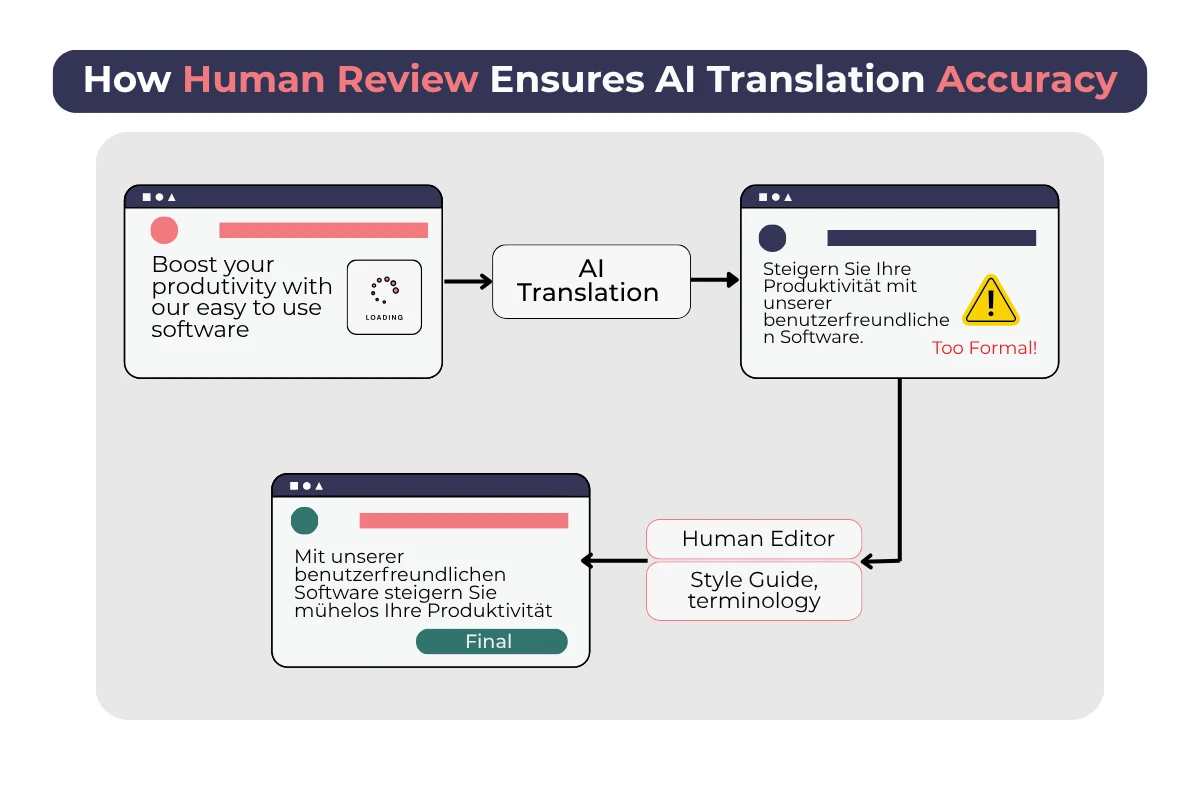
AI Translation with Human Post-Editing
Machine translation post-editing combines automated translation with professional linguistic review.
Providers usually offer two levels:
- Light post-editing corrects major errors and makes the content understandable.
- Full post-editing improves accuracy, terminology, grammar, style, and readability.
Poor AI output can require as much work as human translation, so providers may test a sample before confirming the rate.
Data security can also affect pricing. Confidential content may require a private environment that prevents external systems from storing or training on the material.
AI translation can reduce costs for repetitive, high-volume content. Creative, sensitive, and regulated material requires greater human involvement, which limits potential savings.
What is Your Standard Rate for Translation?
No single rate covers every translation project. A provider may have a base rate, but the final quote will reflect the project requirements.
The same 2,000-word document can cost differently when it contains:
- General internal communication
- Medical instructions
- A legal agreement
- Marketing copy
- Complex formatting
- Certified content
Large or recurring projects may qualify for volume discounts. Long-term clients can also benefit from translation memories and approved terminology databases.
A clear quote should state:
- Pricing unit
- Source volume
- Included services
- Additional fees
- Delivery date
- Revision terms
- Payment terms
Also Read: AI Translation in eLearning: Benefits, Limits, and Costs
Comparing Translation Pricing Models
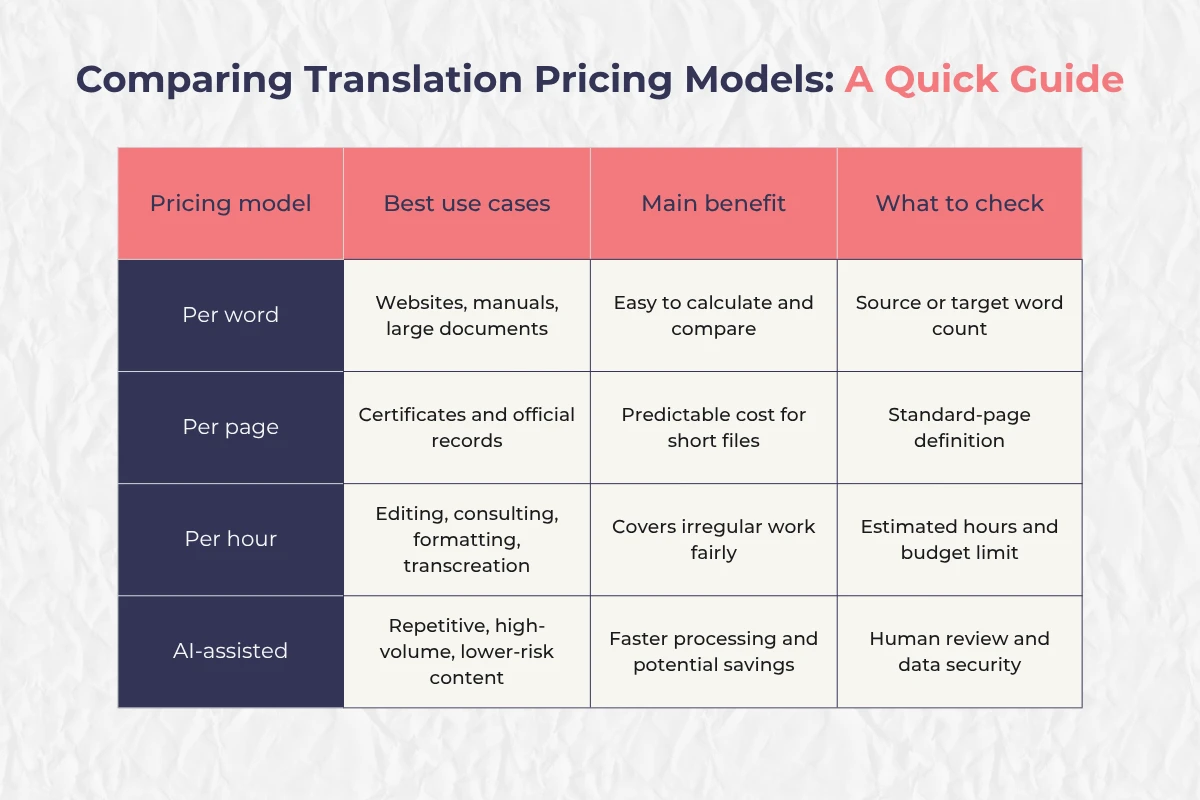
A lower headline rate does not always mean a lower final price. Check whether the quote includes editing, project management, formatting, certification, and quality assurance.
Buyers should also avoid comparing human translation with machine translation post-editing as if they represent the same service.
How to Choose the Right Pricing Model
- Choose per-word pricing for websites, manuals, marketing materials, training content, and large document collections.
- Choose per-page pricing for certificates, diplomas, transcripts, immigration paperwork, and other short official records.
- Choose per-hour pricing for editing, proofreading, consulting, desktop publishing, testing, and creative adaptation.
- Choose AI-assisted pricing for repetitive or high-volume content when the risk level allows it and qualified linguists review the output.
Before requesting a quote, ask:
- Do you use the source-word or target-word count?
- What does the quoted rate include?
- Do you offer translation memory discounts?
- Will you charge separately for formatting?
- Does a second linguist review the translation?
- How do you handle revisions?
- Does the price include certification?
- Will you use AI or machine translation?
- How will you protect confidential data?
How Milestone Prices Translation
At Milestone Localization, we review each project before preparing a quote. We consider the language pair, subject matter, volume, file format, deadline, translation memory matches, and required quality process.
We generally use per-word pricing for text-heavy projects, per-page pricing for short official documents, and hourly pricing for review, localization testing and consulting. When AI-assisted translation suits the content, we define the level of human post-editing and quality assurance in the project scope.
Our quality systems hold certifications under ISO 17100:2015, ISO 9001:2015, and ISO 13485:2016. These standards support qualified linguist selection, documented workflows, quality management, and regulated medical translation processes. Learn more about our certifications and services on Milestone Localization.
Conclusion
There is no straightforward formula for translation pricing because every project has its own language, technical, quality, and delivery requirements.
A detailed project review will give you a more reliable cost than a standard rate, so share your files and expectations with our team at Milestone Localization for a clear, tailored quote.
Get Translation Pricing for Your Project
FAQs
What factors affect translation rates?
Translation rates can vary based on the language pair, content complexity, word count, file format, turnaround time, translator availability, review requirements, certification, formatting, and type of provider.
How much does translation cost per word?
Professional translation rates can vary widely depending on the language pair, subject matter, and quality requirements. General content may cost less, while medical, legal, technical, and other specialized translation typically requires higher rates.
Is translation charged per source word or target word?
Translation providers may calculate pricing using either the source or target word count. Source-word pricing gives buyers a confirmed word count before translation, while target-word pricing can result in a different final count when the target language expands or contracts.
How much does translation cost per page?
Per-page translation rates vary according to the provider, language pair, document type, formatting, certification, and amount of text on each page. Buyers should confirm how the provider defines a standard page before accepting a quote.
When is hourly translation pricing used?
Hourly pricing is commonly used for services where the amount of work cannot be measured accurately by word count. Examples include editing, proofreading, consulting, terminology work, desktop publishing, localization testing, quality assurance, and transcreation.
Does translation memory reduce translation costs?
Translation memory can reduce costs when documents contain repeated or previously translated content. Providers may apply different rates to new words, repeated segments, exact matches, and partial matches, although matched content may still require linguistic review.
How is AI translation priced?
AI translation may be priced by word, character, token, editing effort, subscription, or human post-editing time. The final cost depends on the platform, content volume, quality requirements, and amount of human review required.
Why do specialized translations cost more?
Specialized translation often requires subject-matter expertise, terminology research, additional quality checks, and experienced linguists. Medical, legal, technical, and regulatory content may therefore have different rates from general content.