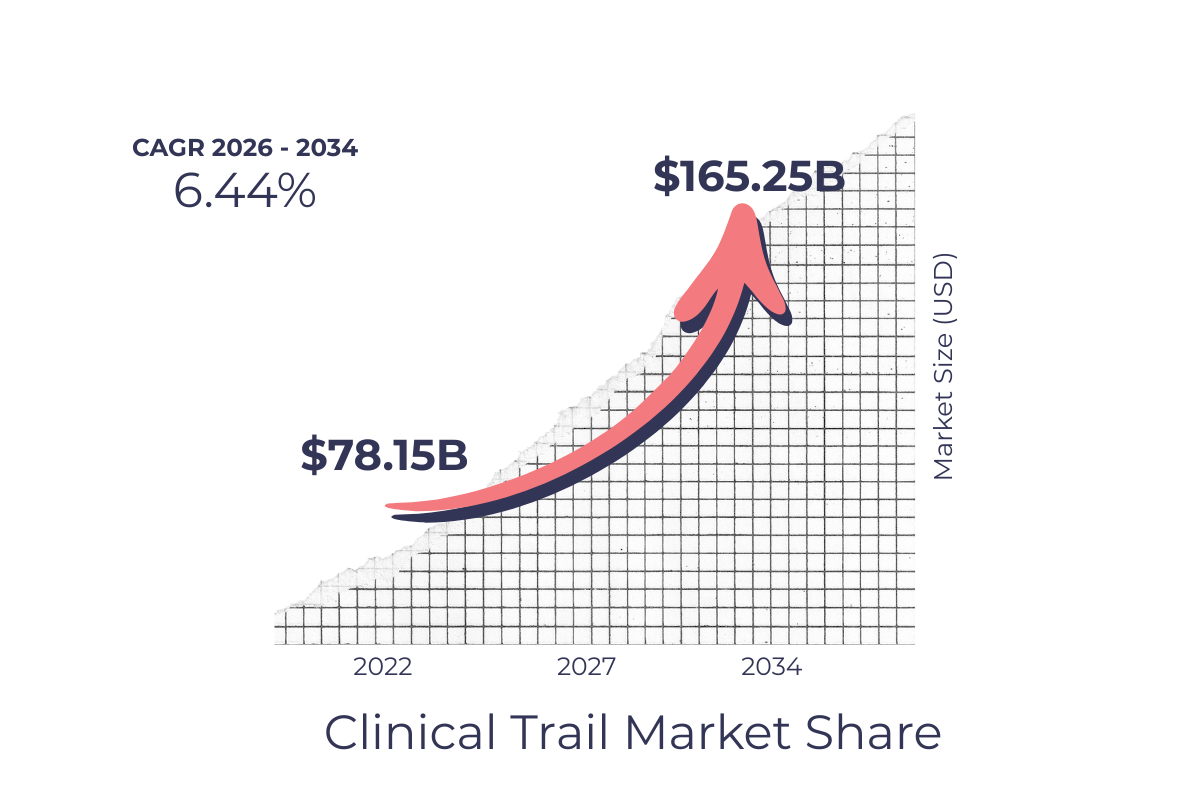
The global clinical trials market could reach $165.26 billion by 2034. As studies expand across countries and languages, they generate vast amounts of content for translation, from protocols and informed consent forms to patient questionnaires and safety reports.
A mistranslated eligibility criterion, safety instruction, or consent statement can mislead participants, raise regulatory concerns, and trigger corrections across multiple markets. When AI in clinical trial content directly affects patient safety and compliance, teams cannot treat AI as a simple replacement for medical translators.
To use the technology responsibly, clinical trial teams need to understand where AI supports translators, where it creates risk, and when human expertise must lead.
Why AI in Clinical Trial Translation Is Different
Clinical trial translation isn’t the same as translating a marketing brochure or a user manual.
Every document supports a clinical study.
- Participants use informed consent forms to understand what they’re signing up for.
- Investigators rely on protocols to run the study correctly.
- Regulators and ethics committees review submissions before a trial can move forward.
That leaves very little room for interpretation.
Medical terms need consistent translations. Regulatory language often follows approved wording. Safety information needs to remain accurate from the first draft to the final approved version.
One small mistake can create a chain reaction.
Imagine an informed consent form uses inconsistent terminology for the same procedure. Reviewers flag the issue. The document goes back for revision. Updated versions need approval across several countries. Site activation slows down, and the study timeline slips.
That’s why clinical trial translation focuses on accuracy first. Speed only matters when the translation still meets medical, regulatory, and quality standards.
Also Read: Translating Clinical Trials: Global Implications And Responsibilities
Where AI Helps
AI delivers the most value when it handles predictable, repetitive work. It speeds up translation and gives linguists a strong starting point without replacing expert review.
1. Translating Repetitive Content
Clinical trial documents contain a lot of repeated language.
Protocol templates, safety statements, investigator instructions, and standard legal text often appear across multiple studies.
AI handles this type of content well. Instead of translating the same sentences repeatedly, linguists can review an AI-generated draft and focus their attention where it matters most.
That reduces turnaround time and cuts unnecessary manual work.
2. Faster Project Delivery
Large clinical trials rarely involve one document in one language.
Sponsors often translate hundreds of files into dozens of languages within tight timelines.
AI helps teams process these large document sets much faster. Translators spend less time creating first drafts and more time reviewing complex sections that require clinical expertise.
3. Supporting Human Translators
AI works best as an assistant.
It can suggest translations, recommend approved terminology, flag inconsistencies, and reduce repetitive editing.
Experienced medical linguists still make the final decisions. They understand context, identify subtle errors, and ensure every document meets the required quality standards.
Where AI Can Create Problems
AI speeds up translation, but it also introduces risk when teams rely on it too heavily.
The main issue isn’t language quality. It’s consistency.
Large language models don’t always produce the same output for the same input. A sentence translated one way in a protocol may appear differently in an informed consent form or investigator brochure. That variation creates extra review work and can raise concerns during audits.
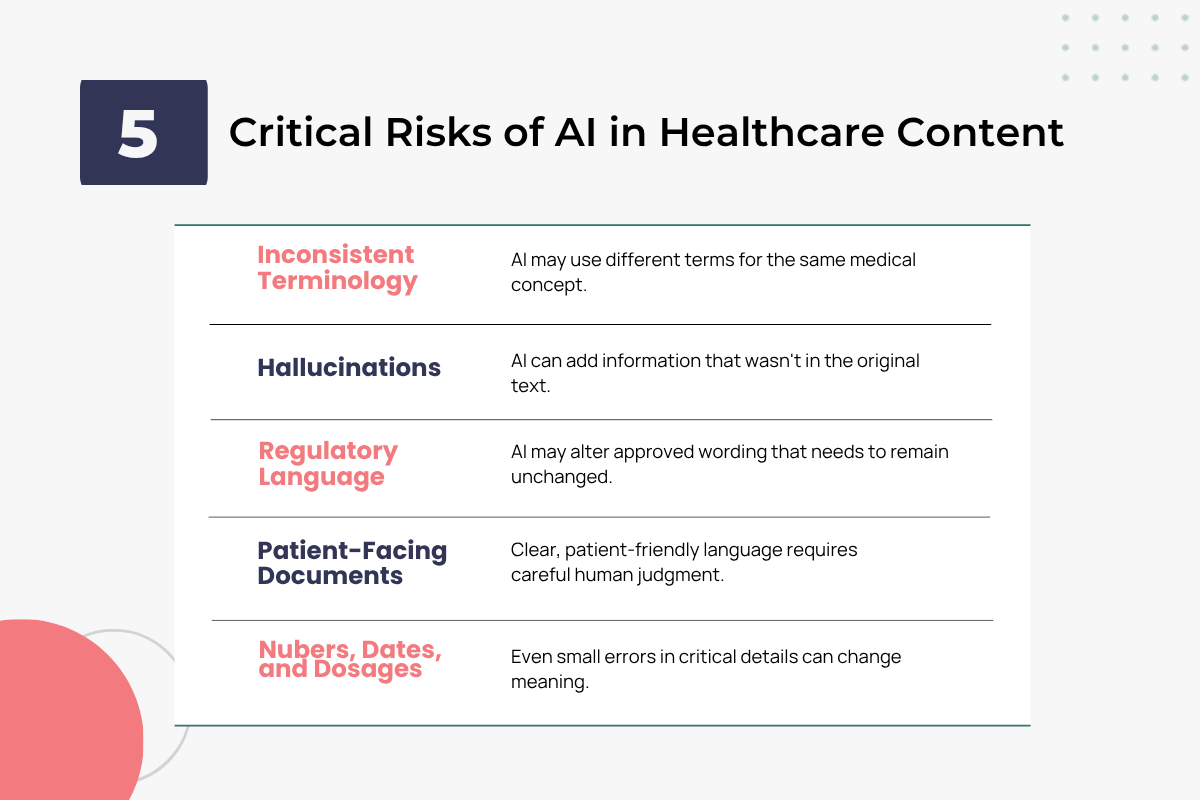
1. Inconsistent Terminology
Clinical trials depend on fixed, approved language.
Medical terms, procedures, and endpoints should stay consistent across all documents. AI doesn’t always follow this unless it’s tightly controlled with terminology databases and translation memories.
Even small wording shifts can confuse reviewers and slow down approvals.
2. Hallucinations
AI can sometimes add information that isn’t in the source text.
It doesn’t happen often, but the impact can be serious in clinical work.
For example, a simple “report headache” instruction could become “report headache and dizziness.” The translation sounds natural, but it changes the meaning.
3. Regulatory Language
Regulatory documents often use approved phrasing that must stay unchanged.
AI may rewrite these sections for fluency, which creates rework for reviewers who must restore the exact wording.
4. Patient-Facing Documents
Informed consent forms, patient diaries, and safety materials need clear, easy-to-understand language.
These documents require more than accuracy. They need clarity and careful wording that supports patient understanding. AI still struggles with that level of judgment.
5. Numbers, Dates, and Dosages
Clinical trial content includes many critical details.
Dosages, visit schedules, units, lab values, and dates must stay exact.
Even a small error can change instructions or create confusion at study sites. Every number needs human verification, no matter how clean the translation looks.
Also Read: Human Vs Machine Translation In Healthcare: Patients’ Safety
Where Humans Still Matter
AI can produce a draft. Human experts decide whether that draft is ready for use.
Their role goes far beyond fixing grammar.
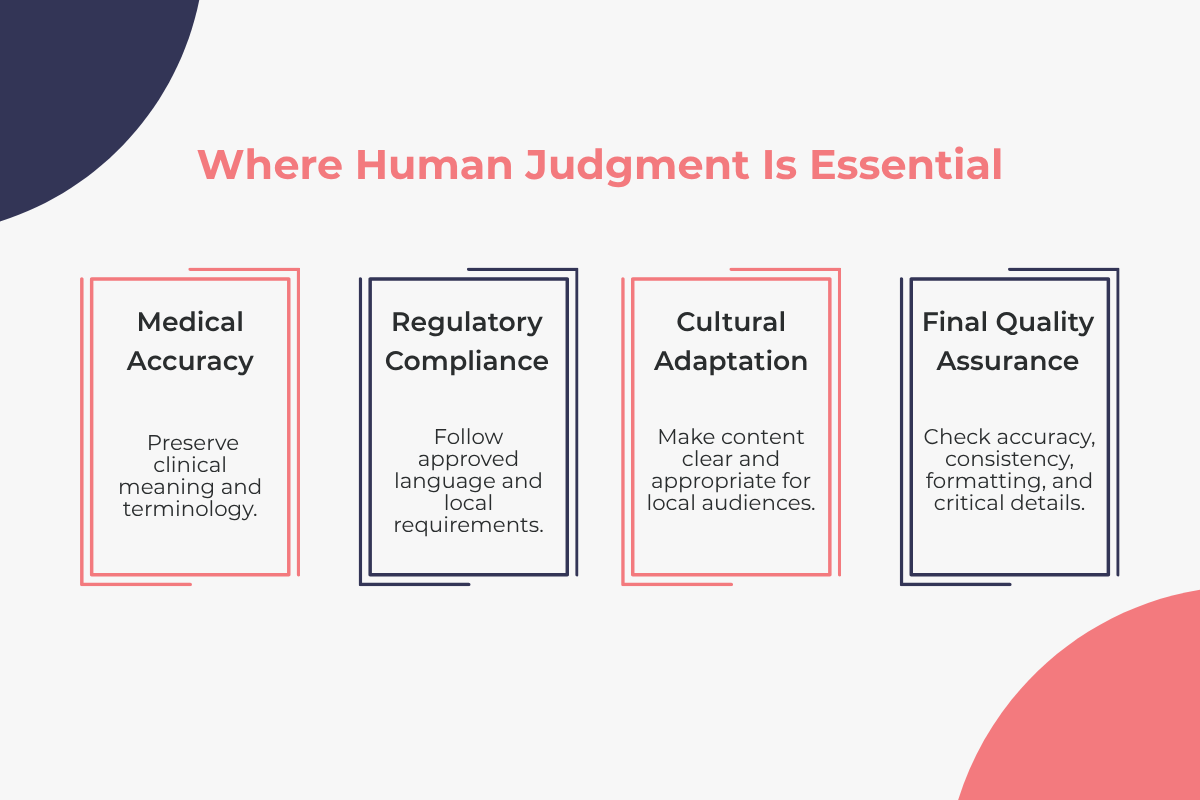
1. Medical Accuracy
Medical linguists understand the science behind the words.
They know when a translation changes the intended meaning, even if the sentence reads naturally.
They also recognize terminology that sponsors, investigators, and healthcare professionals expect to see.
2. Regulatory Compliance
Every market has its own regulatory expectations.
Human reviewers check that translated documents follow approved terminology, local guidance, and sponsor requirements.
They also make sure language stays consistent across the entire study, not just within a single document.
3. Cultural Adaptation
A literal translation doesn’t always communicate the intended message.
Patients in different countries may interpret medical instructions differently. Healthcare systems also use different terminology and writing conventions.
Human linguists adapt the content without changing its meaning. That helps participants understand exactly what’s expected of them.
4. Final Quality Assurance
Every clinical trial translation should go through a final quality review.
This includes checking terminology, formatting, consistency, spelling, numbers, and cross-document references.
QA provides one last opportunity to catch issues before the documents reach investigators, regulators, or study participants.
These documents require more than accuracy
Also Read: ICF Translation: Importance, Requirements & Best Practices
A Practical Tiering Framework
A simple tiering framework helps teams use AI where it adds value and avoid unnecessary risk where accuracy matters most.
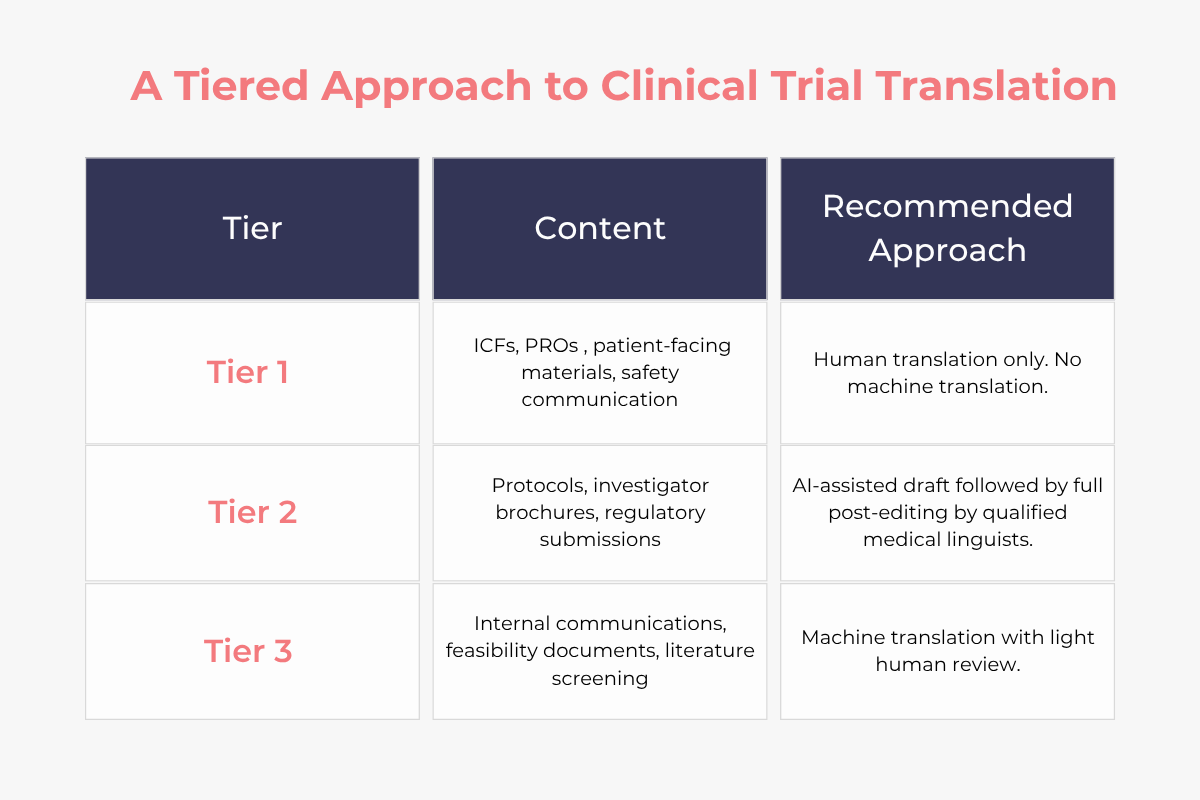
This approach helps teams allocate resources more effectively. They spend the most effort on high-risk content and use AI to improve efficiency where the risk is lower.
A Practical AI-Assisted Workflow
Do not replace translators with AI, build AI into your existing quality process.
A typical workflow looks like this:
- Prepare approved terminology and translation memories.
- Generate an AI-assisted first draft.
- Review the translation with a qualified medical linguist.
- Verify regulatory wording and sponsor terminology.
- Complete linguistic and QA checks before delivery.
Each step builds on the previous one. AI increases speed. Human reviewers ensure the translation meets clinical and regulatory standards.
Before You Use AI, Ask These Questions
Before adding AI to your translation workflow, ask a few simple questions.
- Is this a patient-facing document?
- Does approved terminology already exist?
- Will a qualified medical linguist review the output?
- Does the AI platform meet your security and confidentiality requirements?
- Does this document require consistent wording across multiple study documents?
- Will regulators or ethics committees review this translation?
If the answer to several of these questions is yes, human review should remain an integral part of the process.
Conclusion
Clinical trial documents support patient safety, regulatory compliance, and the success of the study itself. They demand consistent terminology, accurate medical language, and careful quality review.
The strongest translation workflows combine AI with experienced medical linguists.
AI handles the repetitive work. Human experts apply clinical judgment, protect accuracy, and ensure every translated document is ready for real-world use.
Taking your clinical trial global?
FAQs
Can AI be used for clinical trial translation?
Yes. AI can support clinical trial translation by generating first drafts, handling repetitive content, and improving turnaround times. However, high-risk clinical and regulatory documents should receive review by qualified medical linguists.
What are the risks of using AI in clinical trial translation?
Risks include inconsistent terminology, hallucinations, changes to approved regulatory language, errors in numbers or dosages, and inappropriate wording in patient-facing materials.
Does AI replace human translators in clinical trials?
No. AI can assist with repetitive translation tasks, but human medical linguists are still needed to assess clinical meaning, regulatory requirements, cultural context, terminology, and final quality.
Which clinical trial documents require human translation?
High-risk patient-facing and safety-related materials, such as informed consent forms, patient-reported outcomes, and safety communications, generally require careful human translation and review.
How can AI be safely integrated into clinical trial translation?
A controlled workflow can combine approved terminology and translation memories with AI-assisted drafting, qualified medical linguist review, regulatory verification, and final linguistic and QA checks.