
Bulgarian, a South Slavic language with deep historical roots, is one of the oldest written Slavic languages and the first to adopt the Cyrillic alphabet. It carries within it centuries of tradition, folklore, and cultural heritage.
Beyond its grammar and vocabulary, Bulgarian is enriched with expressions that capture complex emotions, social values, and everyday wisdom in ways that often defy direct translation.
In this blog, we talk about ten such untranslatable Bulgarian expressions that highlight the depth and distinctiveness of the language while offering insight into the cultural values it preserves.
10 Untranslatable Bulgarian Expressions
1: Голям праз!

… which funny enough translates into ‘big leek’. As much as Bulgarians are big on leek as it is a prominent part of Bulgarian cuisine, in this expression it means ‘It doesn’t matter or ‘So what!?’.
2: Честито на патерици!

We are all human and unfortunately, oftentimes we happen to forget. To save themselves some trouble, the Bulgarians have this saying which translates into ‘Congrats on crutches!’. Basically, this is a very convenient way to congratulate somebody on an occasion, although a bit late.
3: Айляк
This is a very interesting one, meaning ‘I’m chilling’, and is currently experiencing a kind of a Renaissance. It used to be a part of young people’s slang back in the days when Bulgaria was ruled by the communists. Now three decades later this expression has come back in the spotlight.
4: Куче марка
This one translates as ‘a dog’s brand’ and was initially used to refer to a record player brand whose logo was a dog. Interestingly, throughout the years its meaning has considerably changed and now the Bulgarians use it to name any object of unknown origin and low quality.
5: Как я кара

Number five translates as “How are you driving?” and is a very common way to ask somebody how they are doing.
6: Мани, мани
This phrase, on the other hand, is oftentimes an answer to the question in number 5. It literally means “Remove, remove” or in other words – “Don’t ask, it’s not too good.”.
7: Лягам си, че две не виждам

Everybody has these days when they are so tired that the only thing they want to do is go to bed. Bulgarians have a saying for it: ‘I’m going to bed because I can’t see two’.
8: Само не ми се прави!
This one is a personal favourite. The translation ‘Just don’t make yourself to me’ doesn’t make any sense, though. But let me give you some context: This one is used when somebody is getting on your nerves and you want to tell them ‘Don’t play it so cool in front of me!’. It can come in handy in many situations, I promise!
9: На баба ти хвърчилото
‘Your grandma’s kite’ is usually used to express doubt that something is going to happen – just like it is very unlikely that your grandma plays with a kite, right! A Bulgarian version of ‘When pig’s fly’
10: Всичко е ток и жица
To finish off, this one translates as ‘Everything is electricity and wire’ which sounds mildly ridiculous, however, its meaning is simple: everything is going smoothly and without any problems.
Are You Looking for Bulgarian Translation services?
History of the Bulgarian language
You will be surprised to learn that Bulgarian is the first Slavic language that attained a writing system – what we call today the Cyrillic alphabet. Thus, in antiquity, it refers to Bulgarian as the Slavic language.
Generally, the diachronic development of the Bulgarian language can be divided into four main periods:
1: Prehistoric period (7th – 8th century)
this period is marked by the beginning of the migration of the Slavonic tribes to the Balkans and ends with the shift from the now-extinct Bulgar language to the Old Church Slavonic. This shift initiated with the mission of Saints Cyril and Methodius who created the Cyrillic alphabet. This writing system was based on the Greek one, but a few new letters were added to represent some typically Slavic sounds that were not found in the Greek language.
2: Old Bulgarian period (9th – 11th century)
During this period Saints Cyril and Methodius together with their disciples translated the Bible and other pieces of literature from Greek to Old Church Slavonic.
This was a literary norm of a Common Slavic language from which Bulgarian stems. During this period the Bulgarian language underwent massive changes in terms of simplification of its case system and the development of a definite article.
It was also heavily influenced by its neighbouring countries (Romanian, Greek, Serbian) and later on during the 500-year Ottoman rule – by the Turkish language.
3: Modern Bulgarian (16th – present)
This was an intense period for the Bulgarian language marked by crucial changes in grammar and syntax during the 18th and 19th centuries which eventually led to the standardization of the language.
The modern Bulgarian was heavily influenced by the Russian language, however, during WWI and WWII these Russian loanwords were replaced by native Bulgarian words to a greater extent.
Overall, the historical development of the Bulgarian language can shortly be summarized as the transition from a highly synthetic language (such as Old Bulgarian) to an analytic language (such as Modern Bulgarian).
Also Read: Business in Bulgaria – Why Move your business to Bulgaria?
Bulgarian writing system
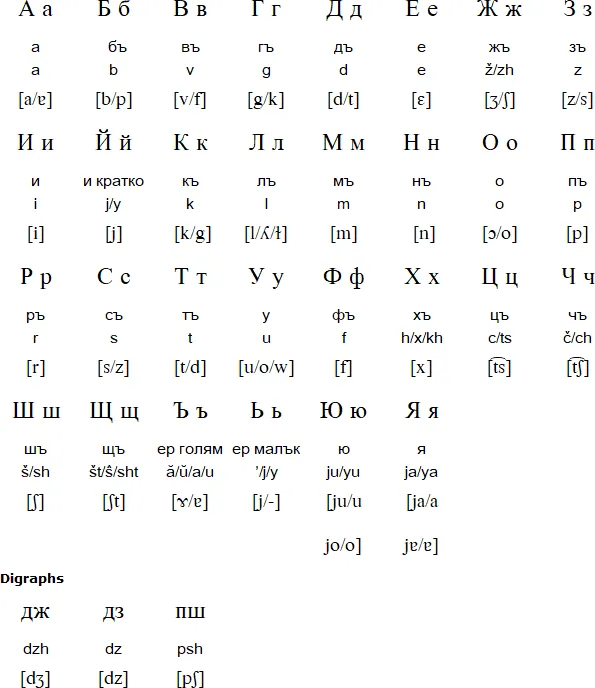
Source:
Also Read: Cyrillic Script: History, Usage and facts
1: Script
Bulgarian uses the Cyrillic alphabet, which has been in use since the 9th century and is deeply tied to the country’s cultural and historical identity.
2: Number of Letters
The modern Bulgarian alphabet contains 30 letters, each representing a distinct sound in the language.
3: Phonetic Nature
Bulgarian spelling is highly phonetic, meaning words are generally written exactly as they are pronounced, making reading and pronunciation more straightforward for learners.
4: Unique Characters
While sharing many letters with other Cyrillic-based languages, Bulgarian includes characters and letter combinations tailored to its own sound system.
Conclusion
As one of the earliest written Slavic languages, Bulgarian embodies both cultural continuity and adaptability. From its beginnings in Old Bulgarian to the modern language spoken today, it has evolved with the times while staying rooted in the Cyrillic script and centuries of tradition.
Even as it changes in a globalized world, its untranslatable expressions preserve the humor, wisdom, and worldview of generations. These phrases show that Bulgarian is not only a tool for communication but also a living symbol of heritage and diversity.
Also Read: Bulgarian vs Russian: Difference and Similarities
Get your content translated into slavic languages
FAQS
Why are some Bulgarian expressions considered untranslatable?
Because they carry cultural, emotional, or historical meanings that don’t have direct equivalents in other languages.
Is Bulgarian a difficult language to learn?
Bulgarian is considered moderately difficult due to its Cyrillic script and complex grammar, but learners find it rewarding once they grasp the basics.
What alphabet does Bulgarian use?
Bulgarian uses the Cyrillic alphabet, which was developed in the 9th century and later adopted by several Slavic languages.
How many people speak Bulgarian worldwide?
Around 7–8 million people speak Bulgarian as their native language, mostly in Bulgaria and neighboring countries.
Is Bulgarian similar to Russian or Serbian?
Yes, to some degree. Bulgarian is a South Slavic language, sharing similarities with Serbian, Macedonian, and Russian, though it has unique grammar rules.
Why is Bulgarian considered the first Slavic literary language?
Because Old Church Slavonic, the earliest written Slavic language, was based on Old Bulgarian in the 9th century.