Medical device manufacturers need translations they can rely on across markets, documents, and product updates. Certifications help buyers assess whether a translation provider has the right processes in place.
ISO 17100 and ISO 13485 are two relevant certifications for medical device translation, and the difference between them matters. ISO 17100 covers how the translation service is delivered. ISO 13485 covers the quality management system behind regulated medical-device work. Together, they set expectations for translation quality, qualified teams, document control, and consistent service delivery.
This article compares ISO 17100 vs ISO 13485 and explains what medical device buyers should expect from a provider certified to both.
ISO 17100: Translation Services Standard
ISO 17100 is an international standard for translation service providers. It sets requirements for the people, processes, and resources involved in delivering professional translation services.
An ISO 17100-certified provider must define how it selects competent translators and revisers, manages project specifications, handles reference material, and checks work before release.
A central requirement is independent revision. A second qualified linguist reviews the translated content against the source. This differs from a translator checking their own work.
For medical device documentation, this structured process matters. Product terminology, warnings, units of measurement, intended-use statements, and recurring instructions need consistent treatment across documents and languages.
What a Buyer Should Expect From an ISO 17100 Provider
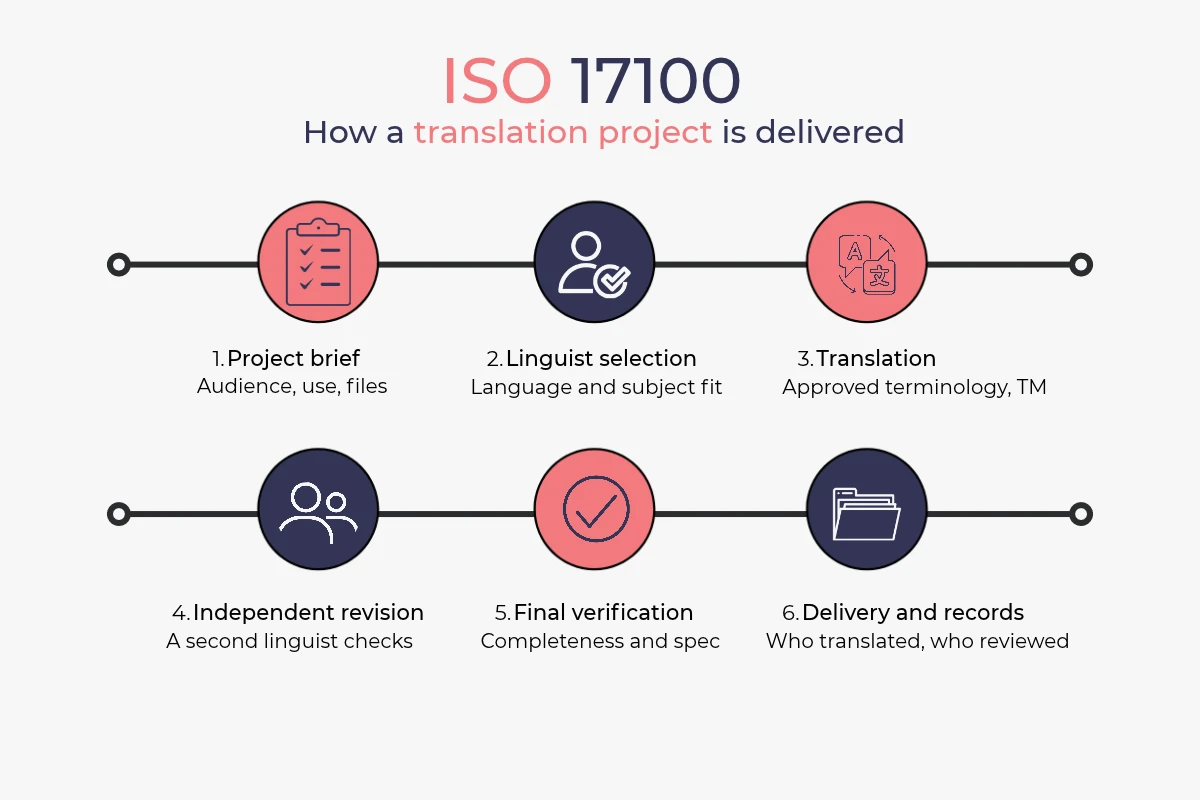
An ISO 17100-certified translation provider should be able to show:
- Translators and revisers qualified for the language pair and relevant subject area
- A defined project brief covering target audience, intended use, file requirements, and reference material
- Controlled terminology and translation memory
- Independent revision before delivery
- Final checks for completeness and compliance with the agreed specification
- Records that show who completed and reviewed the work
Certification does not mean every linguist has clinical or device-specific expertise. Buyers should still ask how the provider assigns linguists to their product category.
Also read: Quality Assurance In Medical Device Translations
ISO 13485: What It Proves About Medical Device Quality Management
ISO 13485 is a quality management system standard for medical devices and related services. It sets out how an organisation should manage quality to meet customer and regulatory requirements consistently.
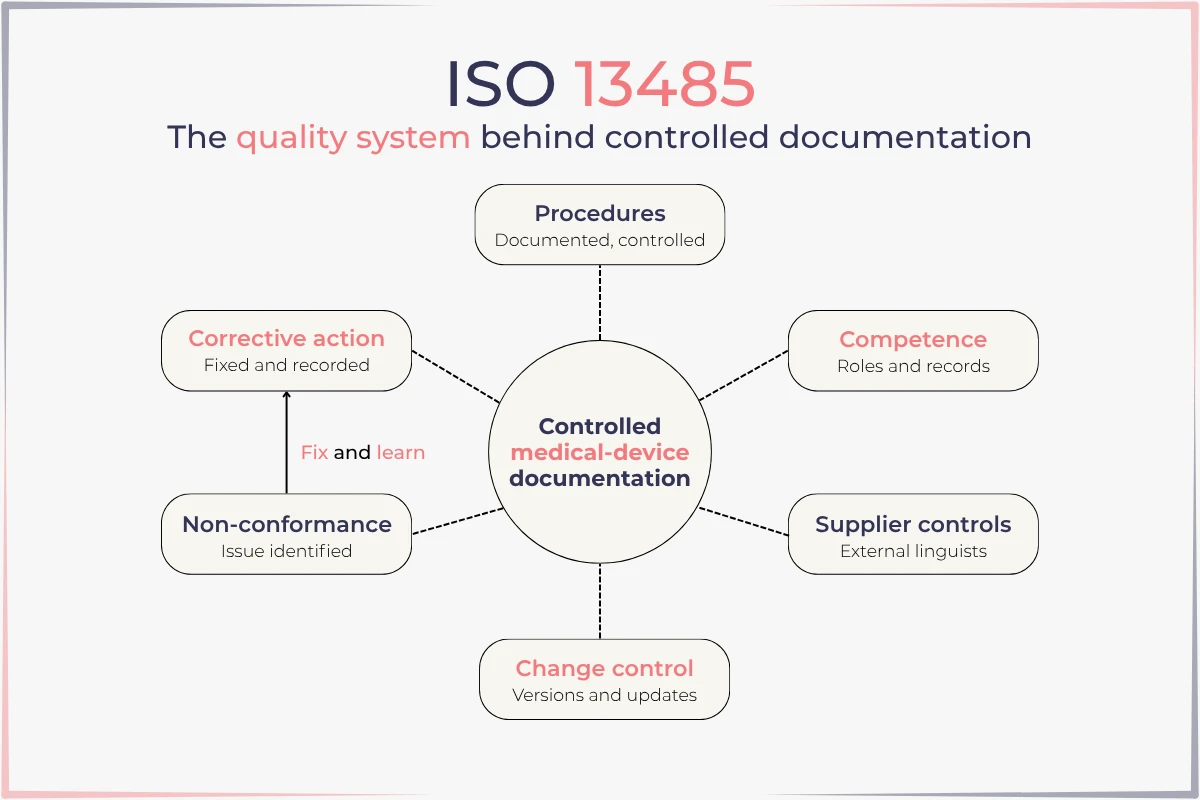
For a translation provider, ISO 13485 indicates that its quality system can support regulated medical-device workflows. It brings formal controls around competence, documented procedures, supplier management, records, nonconformance, corrective action, and change management.
This matters when translated content forms part of a controlled document set. A translation vendor may need to manage source updates, approved terminology, revised artwork, software releases, and urgent post-market communications without losing traceability.
What a Buyer Should Expect From an ISO 13485-Certified Translation Provider
A provider with an ISO 13485-certified quality management system should have:
- Documented procedures for handling regulated content
- Defined responsibilities and competence records
- Controls for subcontractors and external linguists
- Traceable management of document changes and version updates
- Processes for identifying, recording, and correcting nonconformances
- Corrective-action procedures where a quality issue occurs
- Records that support supplier audits and quality reviews
The certification does not make the translation vendor responsible for the device manufacturer’s regulatory obligations. The manufacturer remains responsible for the final content, market requirements, and release decisions.
ISO 17100 vs ISO 13485: The Difference for Medical Device Translation
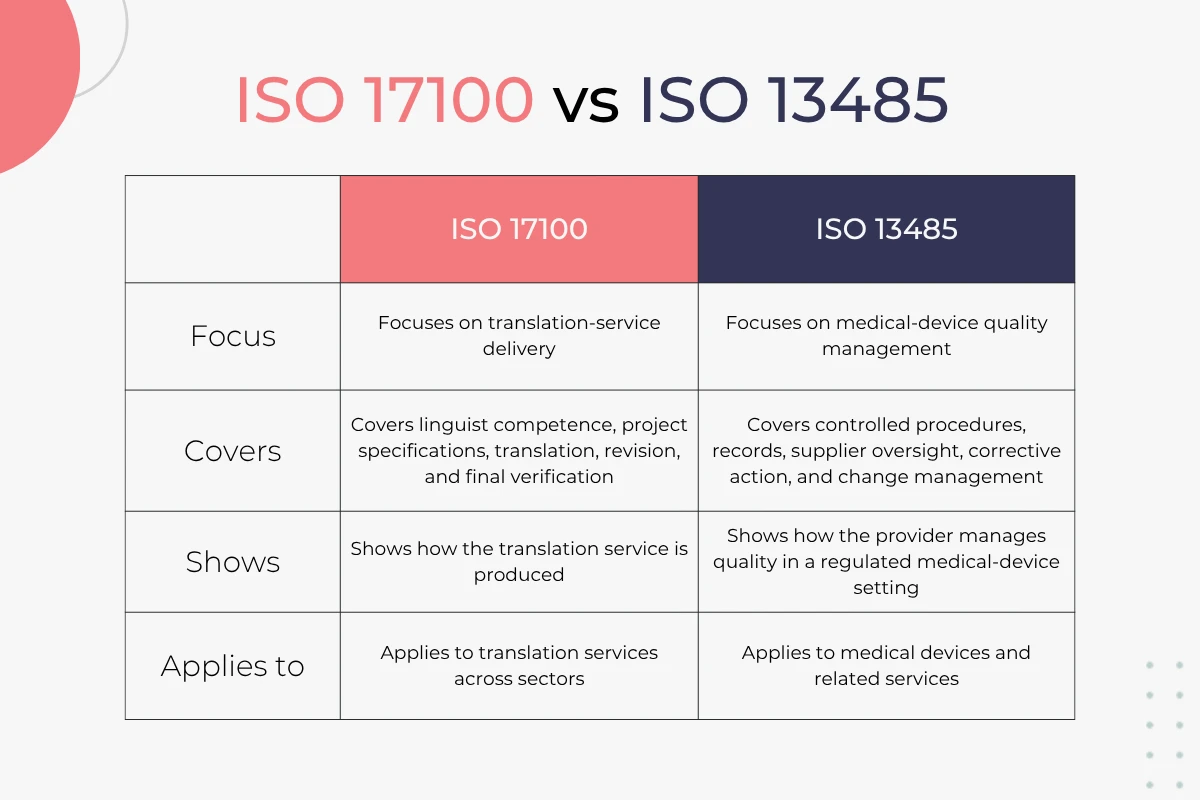
The standards work at different levels. ISO 17100 focuses on the translation project. ISO 13485 focuses on the wider quality system that supports controlled medical-device documentation.
Why Medical Device Manufacturers Need Both
A medical device manufacturer needs confidence in the language work and the process behind it.
ISO 17100 supports the linguistic side. It sets expectations for qualified translators, independent revision, project specifications, and final verification.
ISO 13485 supports the quality-system side. It helps show that the provider can manage controlled documents, supplier relationships, corrective action, and project records in a medical-device environment.
Together, these certifications give buyers stronger evidence that a provider can handle regulated multilingual content with an appropriate level of process control.
This becomes especially relevant for:
- Instructions for use and patient information
- Labels, packaging, and warnings
- Software and user-interface content
- Technical documentation and clinical evaluation reports
- Post-market surveillance reports
- Field safety notices and corrective-action communications
- Notified-body responses and regulatory submissions
Also read: IFU Translation: Importance, Requirements & Best Practices
What These Certifications Do Not Guarantee
Certifications provide a useful starting point, not a complete supplier assessment.
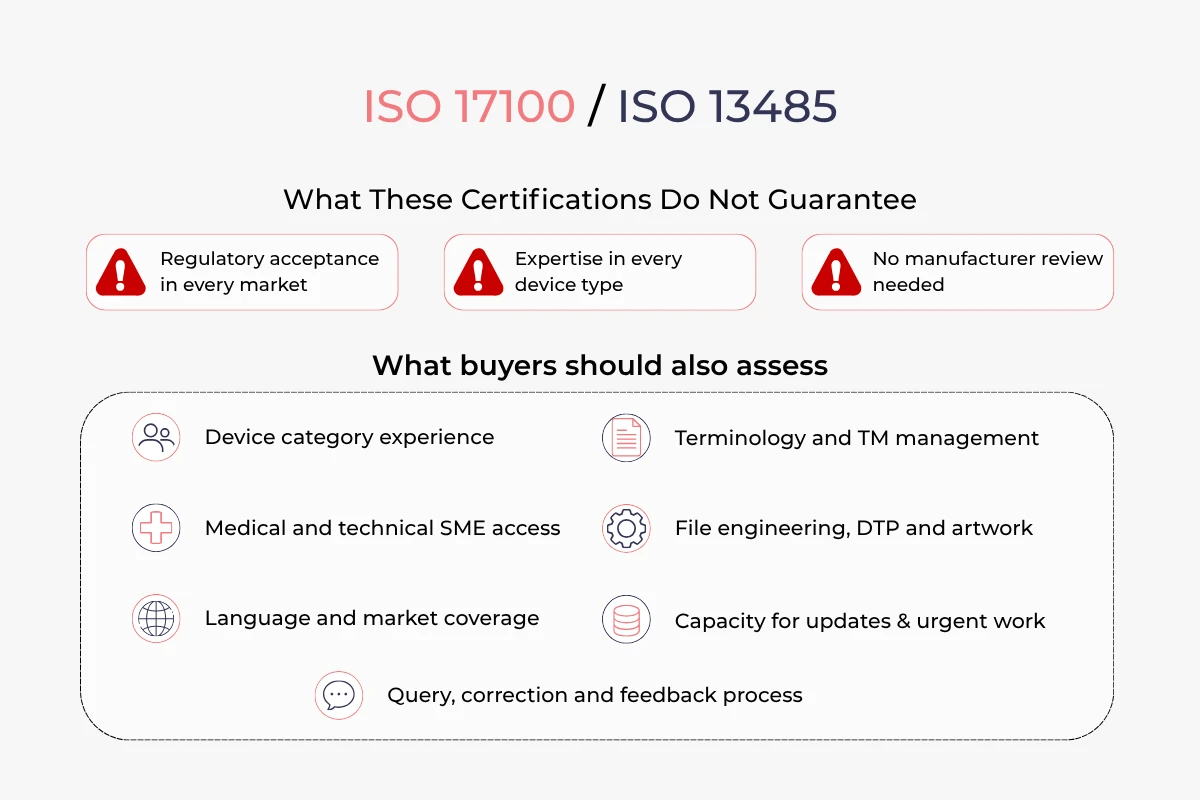
They do not guarantee regulatory acceptance in every market. They do not confirm that a provider understands every device type. They also do not remove the need for manufacturer review and approval.
Medical device buyers should also assess:
- Experience with their device category
- Access to medical and technical subject-matter expertise
- Coverage for required languages and target markets
- Terminology and translation-memory management
- File engineering, desktop publishing, and artwork support
- Capacity to manage frequent updates and urgent projects
- Processes for handling queries, corrections, and feedback
Ask to see how the provider applies its certifications in practice. A certificate matters most when the underlying process appears in the way the team manages the project.
Also read: Medical Device Translation Requirements as per EU MDR
Choosing an ISO-Certified Partner for Medical Device Translation
Milestone Localization holds ISO 17100, ISO 13485, and ISO 9001 certifications. We combine translation-service controls with a medical-device-focused quality management system and consistent service-delivery processes.
We support IFUs, labels, technical documentation, software, clinical content, and post-market documentation in more than 70 languages. Our teams work with qualified linguists, independent revision, controlled terminology, and structured project records.
For manufacturers managing MDR requirements, global launches, and regular documentation updates, we provide a controlled approach to multilingual content across the product lifecycle.
Conclusion
A certification should lead to practical questions: Who will translate and review the documents? How will the team manage terminology, updates, and corrections? Can the provider provide the records required for supplier review?
ISO 17100 and ISO 13485 give buyers a framework for asking those questions.
The right partner can explain its process clearly and apply it consistently across every language and document type.
Looking for a Reliable Medical Device Translation Partner?
FAQs
What is the difference between ISO 17100 and ISO 13485?
ISO 17100 covers translation service requirements, while ISO 13485 focuses on quality management systems for medical devices and related services.
Why are ISO 17100 and ISO 13485 important for medical device translation?
They provide evidence of structured translation processes and quality management controls for regulated medical device documentation.
Does ISO 13485 certification guarantee accurate medical device translations?
No. Buyers should also assess linguistic expertise, independent revision, terminology management, and medical device experience.
What documents require medical device translation?
Common examples include instructions for use (IFUs), labels, packaging, technical documentation, clinical reports, and field safety notices.
What should buyers check when choosing an ISO-certified translation provider?
Buyers should review certification scope, relevant experience, linguist qualifications, document control, language coverage, and revision processes.
Should a medical device translation provider hold both ISO 17100 and ISO 13485 certifications?
Both certifications can offer complementary assurances about translation services and quality management. Buyers should verify their scope and assess the provider’s practical capabilities.